
Wireless Charging for Agricultural Autonomous Vehicles
Agricultural autonomous vehicles are becoming an important part of smart farming. They can transport materials, spray crops, sow seeds, apply fertilizer, inspect plants and collect field data across farms, orchards and greenhouses. These vehicles typically combine positioning, lidar, machine vision, autonomous navigation and remote fleet management.
Agricultural work is seasonal, time-sensitive and often performed in demanding outdoor conditions. Mud, water, dust, chemicals, fertilizer, temperature changes and uneven ground can all affect conventional charging connectors. With wireless charging, a vehicle can dock automatically at a parking area or field service point and recharge without manual cable handling.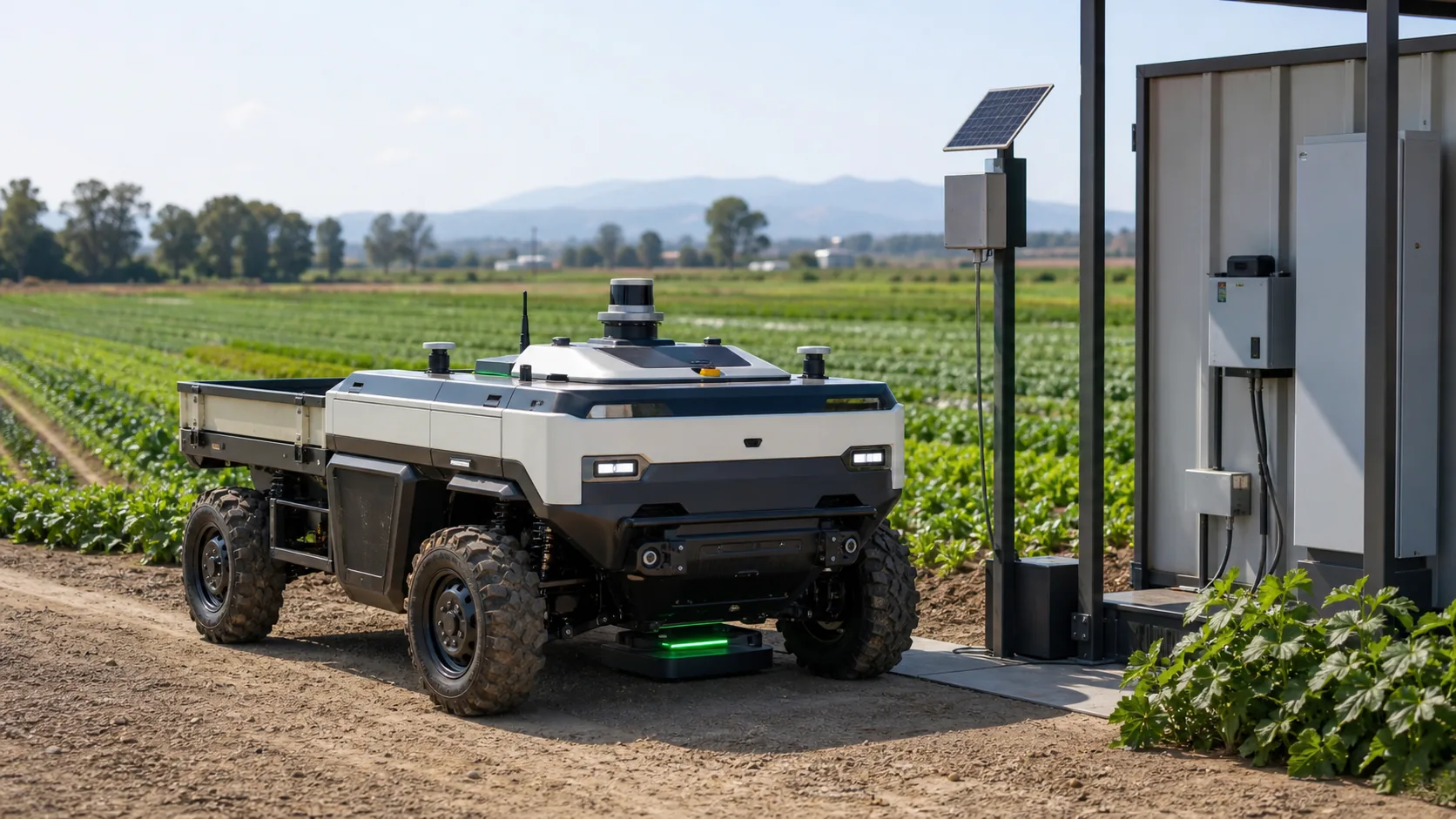
Why do agricultural autonomous vehicles need automatic charging?
During planting, spraying and harvesting seasons, agricultural vehicles may need to operate across several shifts. Waiting for a worker to connect a charger every time the battery runs low interrupts the workflow and adds another manual task. As fleets grow, manual charging can become a bottleneck for the entire automation system.
An automatic charging system can schedule recharging according to battery status and current tasks. The vehicle docks at the charging point, replenishes its battery to a defined level and then returns to work, making energy management part of the autonomous operating cycle.
Benefits of wireless charging in agricultural environments
- Less manual handling: Vehicles return to the charging point without workers repeatedly connecting cables.
- Reduced connector contamination: Contactless power transfer limits the exposure of metal contacts to mud, dust, water, chemicals and fertilizer.
- Lower mechanical wear: Eliminating repeated plug-in cycles reduces the risk of damaged connectors and poor contact.
- More continuous operation: Vehicles can recharge between tasks instead of remaining offline for one long charging period.
- Better fleet coordination: The charging system can work with farm management software to schedule charging for multiple vehicles.
Which agricultural vehicles can use wireless charging?
Suitable applications include autonomous transport vehicles, crop-spraying vehicles, orchard inspection vehicles, seeding and fertilizing machines, greenhouse utility vehicles and transport platforms supporting harvesting robots. Vehicles with repeatable routes and regular parking or service points are especially well suited to automatic wireless charging.
Where should the charging station be installed?
A charging station can be placed in a machinery shed, material supply area, field service point or at the end of a greenhouse aisle. The transmitter should use a compact, low-profile structure that does not obstruct vehicle movement and should be protected from standing water and heavy soil buildup. Receiver installation must account for ground clearance, suspension movement and the available space under the chassis.
Key system design considerations
A wireless charging system should be matched to the vehicle battery voltage, required charging power, chassis height, docking accuracy, allowable misalignment, charging distance, protection rating and communication interface. Outdoor projects should also address waterproofing, dust protection, corrosion resistance, heat dissipation, foreign-object detection and operating temperature.
In practical deployments, the charging controller should communicate with the vehicle BMS, vehicle controller and farm fleet management platform. Battery level, charging status, faults and completion signals can then be shared to support automatic return, charging confirmation and task resumption.
Conclusion
For agricultural autonomous vehicles to progress from individual automated tasks to long-term unattended operation, they need reliable automatic recharging. Wireless charging reduces manual connection and connector maintenance, improves charging reliability in dirty outdoor environments and integrates with vehicle scheduling and battery management. As smart farms deploy more autonomous equipment, wireless charging for agricultural autonomous vehicles will become an increasingly valuable part of the supporting infrastructure.