
Wireless Charging for Autonomous Cleaning Boats
Autonomous cleaning boats are intelligent environmental protection equipment used in rivers, lakes, park water systems, reservoirs and harbors. They can clean floating waste, salvage aquatic plants, monitor water quality, inspect shorelines and support water surface maintenance. Compared with manually operated cleaning boats, autonomous cleaning boats can plan routes, avoid obstacles, perform fixed-point operations and send back operating data automatically.
The particularity of surface operations determines that cleaning boats have higher requirements for charging methods. Traditional plug-in charging requires personnel to operate on the shore or dock. The charging interface is exposed to moisture, rain, sediment and water vapor for a long time, which is prone to corrosion, poor contact and increased maintenance costs. When wireless charging is applied to autonomous cleaning boats, the hull can align with a shore-side or floating charging module and recharge automatically.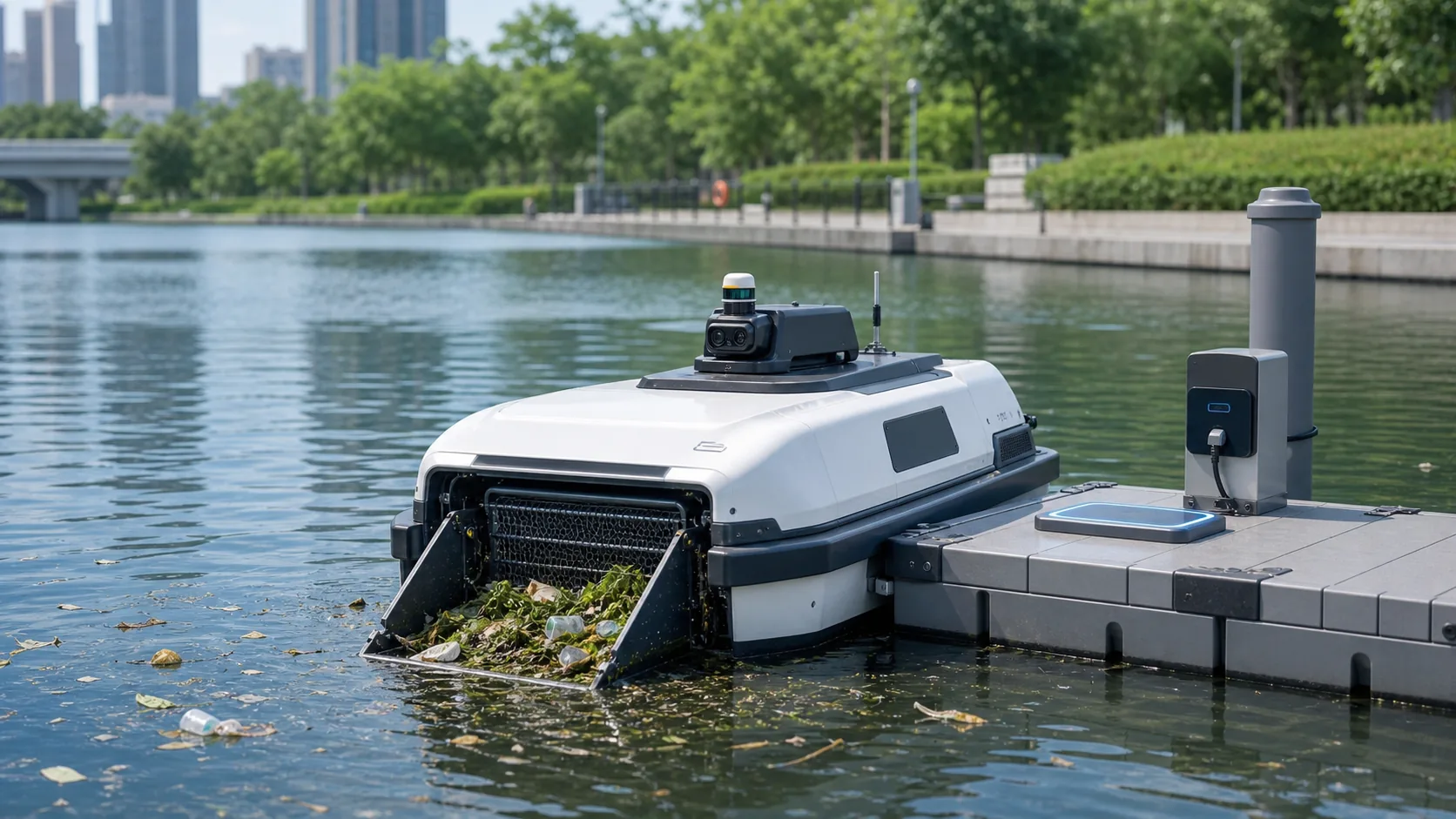
Why do autonomous cleaning boats need to automatically recharge?
Autonomous cleaning boats usually need to cruise repeatedly in fixed waters, with long operation cycles and high task frequency. The efficiency of autonomous systems will be limited if staff need to tow the boat, connect cables or replace batteries every time the battery is low. The automatic charging system allows the cleaning boat to return to the charging point autonomously when the battery is low or after the mission is completed, reducing personnel intervention.
For urban rivers, park lakes and enclosed waters, fixed shore charging points are easier to deploy. The wireless charging module can be integrated into shore berths, floating docks or small docking racks, allowing the cleaning vessel to automatically enter charging status after berthing.
Core advantages of wireless charging
- Reduce interface problems in humid environments: Non-contact charging reduces the exposure of metal contacts and reduces the impact of water vapor, rain and corrosion on the interface.
- Reduce the frequency of manual maintenance: The cleaning boat can automatically dock to recharge, eliminating the need for staff to frequently plug and unplug cables.
- Improve continuous operation capabilities: Can be combined with the task scheduling system to automatically return to home for charging when the battery is low, and continue the cleaning task after charging is completed.
- Suitable for small terminal deployment: Charging modules can be made into compact shore equipment or floating berths without the need for large-area platforms.
- Improve the level of intelligent water management: After wireless charging is linked with positioning, communication, power management and remote monitoring, it can form a complete unattended closed loop.
What application scenarios is it suitable for?
Wireless charging for autonomous cleaning boats is suitable for use in urban rivers, park lakes, landscape water systems, reservoir management areas, port inner bays, industrial park canals and closed breeding waters. These scenarios usually have clear water boundaries and relatively fixed routes, and have the conditions to set up shore charging points or floating charging berths.
What factors need to be paid attention to in system design?
When configuring a wireless charging system for an autonomous cleaning boat, it needs to be designed based on the hull size, battery voltage, target power, berthing accuracy, charging distance, berth structure, waterproof rating, communication interface and on-site water level changes. If it is used in outdoor waters, waterproofing, corrosion resistance, wind and wave resistance, fixation methods and long-term maintenance convenience should also be considered.
In actual deployment, the wireless charging system can be linked with the hull BMS, power monitoring, automatic return, berthing positioning and background dispatch platform. When the cleaning boat's power is lower than the set threshold, the system automatically plans a return path and continues to perform water surface cleaning tasks after docking to complete charging.
Summary
To achieve stable, efficient and low-manpower operation of autonomous cleaning boats, the ability to automatically recharge is very critical. Wireless charging can reduce the pressure of interface maintenance in humid environments and improve the continuous operating capability of water surface environmental protection equipment through non-contact, miniaturization and automatic docking for charging. With the development of smart water services and unattended environmental protection equipment, Wireless charging for autonomous cleaning boats will become important infrastructure in the management of urban rivers, landscape lakes and closed waters.