
China's Livestock Robot Industry: Intelligent Farming and Market Growth
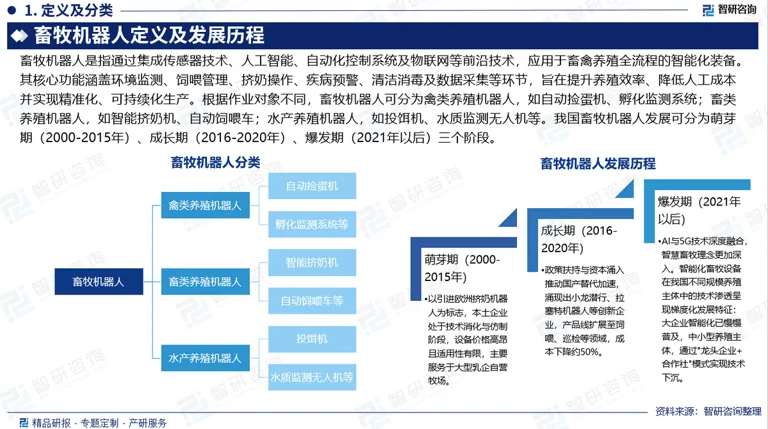
In recent years, livestock robots, as intelligent equipment integrating cutting-edge technologies such as sensor technology, artificial intelligence, automated control systems, and the Internet of Things, are causing a revolutionary change in the field of livestock and poultry breeding. These high-tech "breeding assistants" not only cover all-round functions such as environmental monitoring, feeding management, milking operations, disease warning, cleaning and disinfection, and data collection, but also significantly improve breeding efficiency, reduce labor costs, and lead the livestock industry to transform into a precise and sustainable production model.
Driven by the two-wheel drive of policy promotion and technological progress, my country's livestock robot market has ushered in unprecedented development opportunities. Data shows that in 2024, my country's livestock robot market size has reached 1.87 billion yuan, achieving a significant growth of 20% year-on-year. It is expected that this number will further climb to more than 2.2 billion yuan by 2025. Although livestock robots are still in the initial stage of development and their application scale is relatively small, their huge potential and broad prospects cannot be underestimated.
Judging from the types of livestock robots, feeding robots account for a large share of the market, accounting for about 35%, due to their high efficiency and convenience. In the practice of large-scale breeding, feeding robots have been widely used, effectively improving the accuracy and efficiency of feeding. Milking robots follow closely behind, accounting for about 25%, bringing significant automation improvements to dairy farming. Inspection robots and cleaning and disinfection robots also occupy 20% and 15% of the market share respectively, providing strong support for the intelligent management of livestock farming. Although other robots with functions such as sorting and weighing account for a relatively small proportion, they also play an irreplaceable role in specific fields.
China's livestock robot industry: Intelligent transformation is accelerating and the market prospects are broad
Behind the rapid development of the livestock robot market are the challenges posed by the aging of the population and the shortage of rural labor. As labor costs continue to rise, breeding companies are facing increasing cost pressure. The emergence of livestock robots provides an effective solution to this problem. They can not only alleviate the shortage of agricultural labor, but also significantly reduce the labor costs of breeding and improve overall economic benefits.