
Wireless Charging for Coal Mine Quadruped Inspection Robots
The coal mine inspection scene is gradually moving from manual inspection and fixed camera monitoring to mobile robot autonomous inspection. Compared to wheeled or tracked robots, quadruped robots have stronger obstacle surmounting ability and terrain adaptability, and is suitable for areas with complex environments and irregular passages such as coal mine substations, underground tunnels, belt corridors, and pump rooms. To make a quadruped robot truly unattended for a long time, in addition to navigation, perception and obstacle avoidance capabilities, wireless charging is also critical infrastructure.
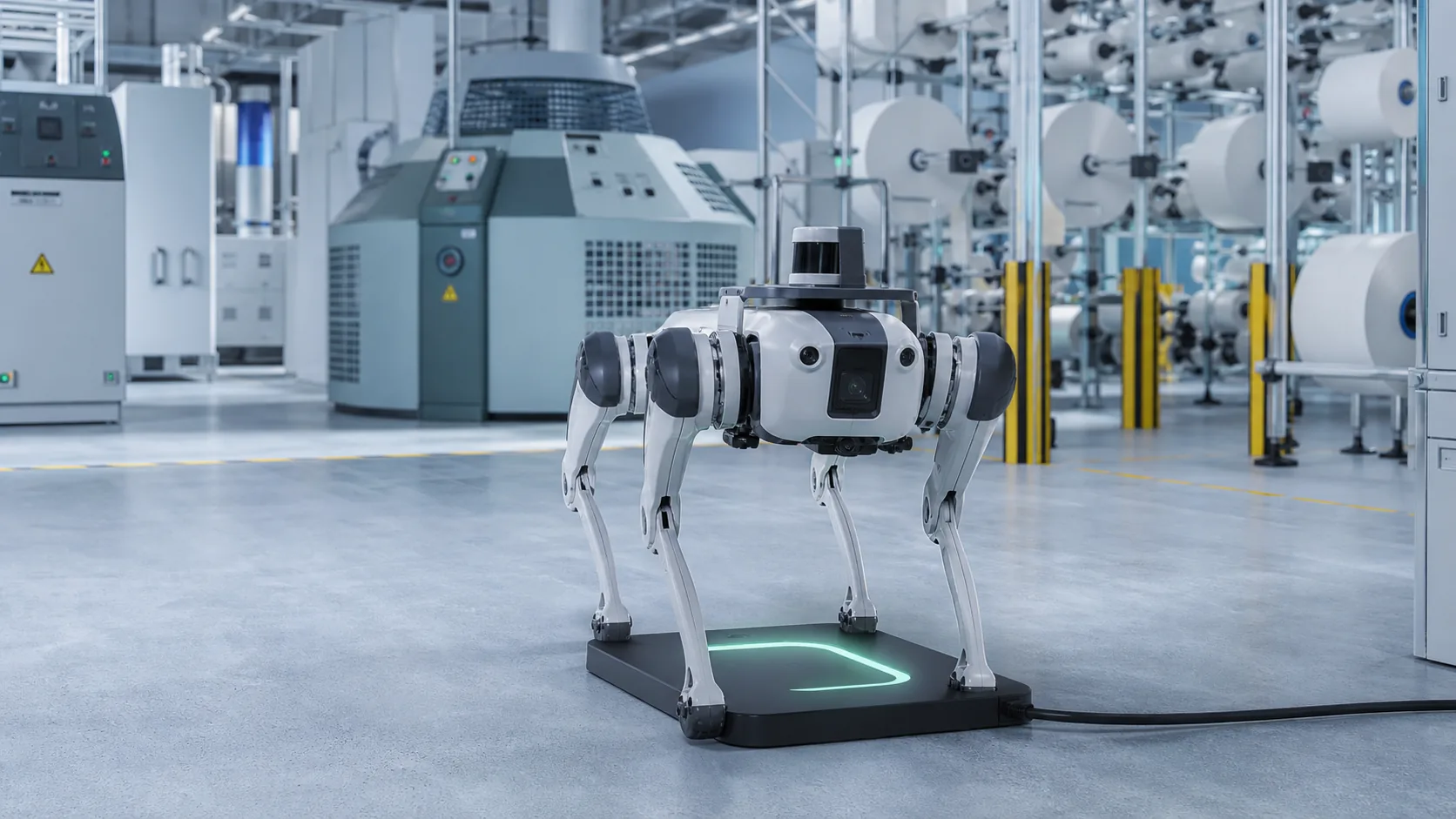
1. Core capabilities of the coal mine quadruped robot inspection system
The "Design and Research and Development of Coal Mine Quadruped Robot Inspection System" published in "Smart Mine" proposes that the coal mine quadruped robot inspection system needs to integrate multi-sensor fusion capabilities such as lidar, inertial measurement unit, leg joint encoder, etc., and combine it with autonomous navigation algorithms to achieve autonomous mapping, path planning, dynamic obstacle avoidance and autonomous charging.
- Autonomous mapping: Use lidar to identify the spatial structure of tunnels, equipment rooms and inspection channels;
- path planning: Automatically generate walking routes based on inspection points, reducing reliance on manual remote control;
- Dynamic obstacle avoidance: Automatically adjust the route when facing temporary obstacles, changes in personnel and equipment;
- Environmental collection: Equipped with cameras, thermal imaging, gas, temperature and humidity and other modules to complete inspections;
- Autonomous recharge: When the battery is low or the task is completed, it will automatically return to the charging point to recharge.
2. Why quadruped robots are more suitable for wireless charging
Quadruped robots usually undertake high-frequency, long-term, and cross-regional inspection tasks. If you still rely on manual cable plugging for charging, the value of unattended inspection will be weakened. There are also dust, moisture, vibration and flammable and explosive risks in the coal mine environment. Exposed contacts are prone to oxidation, poor contact, frequent maintenance and other problems.
The non-contact charging method of wireless charging is more suitable for quadruped robots: the robot only needs to walk to the charging position autonomously and keep the receiving end and transmitting end within the allowable offset range to automatically start charging. The abstract of the paper mentioned that the wireless charging positioning accuracy during system testing was less than 5 cm. This type of accuracy can already support automatic recharging applications at fixed charging points.
| Compare items | contact charging | wireless charging |
| Docking method | Requires precise contact with contacts or plugs | A certain position deviation is allowed, making docking more friendly. |
| environmental adaptability | Susceptible to dust, moisture and oxidation | No exposed electrodes, can be sealed and protected |
| Maintenance cost | Contacts need to be cleaned and replaced after wear | No mechanical contact, lower maintenance |
| security | There are potential risks of contact sparks and electric leakage | Contactless transmission, suitable for scenarios with high security requirements |
| Degree of dehumanization | It is often necessary to manually check the docking status | Can be linked with the navigation system to automatically recharge |
3. Charging logic during inspection of coal mine substations
Coal mine surface substations, underground substations and distribution chambers usually have dense equipment and fixed inspection points, making them suitable for deploying quadruped robots and fixed wireless charging stations. The robot inspects switch cabinets, transformers, cable trenches, instruments, temperature rise and environmental conditions as planned, and automatically returns to the charging point after the task is completed.
- The robot completes equipment inspection and data collection according to the task route;
- When the power is lower than the threshold or after the task is completed, the system triggers autonomous recharging;
- The robot enters the wireless charging area through navigation and positioning;
- Charging starts after the transmitter and receiver communicate and confirm;
- Charging status, battery temperature, and fault information are uploaded to the inspection platform.
4. Key points of wireless charging system design
The wireless charging solution for quadruped robots should not only look at the power, but also be designed based on the robot chassis structure, charging posture, docking accuracy, task frequency and coal mine site safety requirements.
- Installation location: The transmitting end can be arranged on the wall, the ground or a fixed bracket, and the receiving end can be installed on the side or bottom according to the robot posture;
- Positioning tolerance: It should match the accuracy of the robot’s autonomous navigation to avoid recharge failure caused by too strict alignment;
- Protection level: In coal mine scenarios, it is recommended to pay attention to dustproof, waterproof, anti-corrosion and shell strength;
- Communication interface: Linked with BMS, robot controller and inspection platform to provide real-time feedback on charging status;
- Security protection: Over-temperature, over-voltage, over-current, foreign object detection and abnormal shutdown protection cannot be omitted.
5. The value of intelligent inspection of coal mines
The abstract of the paper shows that the quadruped robot in the coal mine can move autonomously and smoothly in actual scene tests, complete environmental data collection and real-time monitoring, and the inspection speed is up to 0.6 m/s. For the coal mine inspection system, this means that the four-legged robot has the foundation to move from "able to walk" to "able to inspect, recharge, and continue to operate."
The addition of wireless charging can transform quadruped robots from single-task devices into long-term online devices. The robot no longer relies on manual cable plugging, nor does it require frequent battery replacement. The inspection system can automatically operate according to shifts, routes, and alarm tasks, which is more in line with the requirements of intelligent construction of coal mines for reducing personnel, increasing safety, and improving efficiency.
Conclusion
The core of the development of the coal mine quadruped robot inspection system is not only the improvement of the performance of the robot body, but also the systematic capabilities of navigation, perception, communication, charging and platform linkage. Wireless charging allows quadruped robots to have automatic recharging and unattended operation conditions, which is an important part of coal mine inspection robots moving from demonstration applications to normal operation.
Reference: Fu Xin and Zhu Xishuo, "Design and Research and Development of Quadruped Robot Inspection System for Coal Mines", "Smart Mine", Volume 6, Issue 11, 2025, pages 71-75.