
Wireless Charging for Autonomous Forklifts
Autonomous forklifts are widely used in automated warehouses, smart factories and logistics centers. They can handle pallet pickup, material transfer, production-line delivery and warehouse replenishment using lidar, machine vision, navigation, obstacle avoidance and fleet management software.
The charging method directly affects vehicle availability. Manual cable connection interrupts unattended workflows, while exposed contact chargers can be affected by dust, oxidation, docking errors and mechanical wear. With wireless charging, an autonomous forklift can dock and recharge without manual connection or exposed electrical contacts.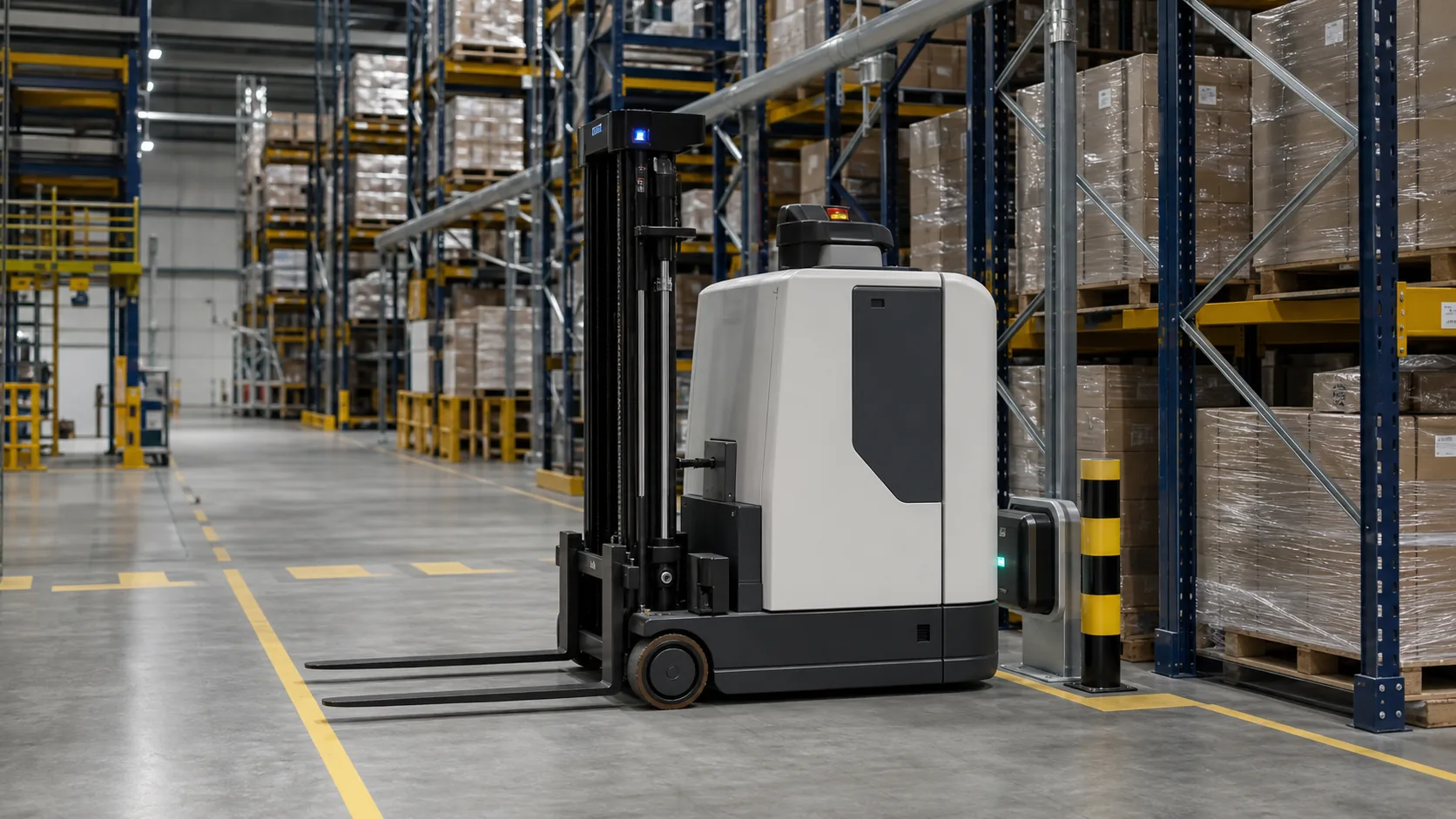
Why do autonomous forklifts need automatic charging?
Warehouse and production logistics often operate across multiple shifts. If a low-battery vehicle must wait for an operator, the automated workflow is interrupted. As fleets grow, manual charging can also create queues, missed charging events and higher maintenance costs.
Automatic charging allows the fleet management system to schedule recharging according to battery level, task priority and charger availability. Vehicles can top up during idle periods or between jobs, then return to work after reaching the required charge level.
Benefits compared with contact charging
- No manual cable handling: The vehicle docks and starts charging automatically, including during unattended night shifts.
- Fewer contact failures: The absence of exposed electrodes reduces oxidation, contamination, wear and poor electrical contact.
- Practical docking tolerance: A properly designed transmitter and receiver can accommodate normal repeat-parking errors.
- Opportunity charging: Vehicles can recharge during loading delays, task changes and other short idle periods.
- Simpler maintenance: There are fewer connectors and charging contacts to clean, replace or mechanically service.
How is the wireless charging system installed?
A typical system includes a transmitter, transmitting coil, onboard receiver, receiving coil and communication controller. The transmitter can be installed beside a wall, on a column or at a fixed parking position, while the receiver is mounted on the side or underside of the forklift. A compact, low-profile arrangement helps keep warehouse aisles clear.
Docking can use lidar navigation, floor markers, machine vision or the vehicle's existing positioning system. Power transfer begins only after the vehicle enters the permitted alignment range and stops if the system detects a foreign object, excessive temperature, communication fault or vehicle movement.
Key parameters for system selection
The wireless charging system should be matched to the battery chemistry, battery voltage, charging power, current, allowable misalignment, transfer distance, parking duration and available installation space. High-current applications also require suitable cable sizing, thermal management, protection logic and electromagnetic compatibility.
The charging controller should communicate with the forklift BMS, vehicle controller and fleet management system. Sharing battery level, charging permission, operating status, faults and completion signals allows the vehicle to select a charger, dock, confirm charging and resume work automatically.
Typical applications
Wireless charging for autonomous forklifts is suitable for smart warehouses, automotive plants, food and beverage production, cold-chain logistics, port storage and large distribution centers. It is especially useful where vehicles operate frequently, follow predictable routes, work across multiple shifts or run in areas with limited manual access.
Conclusion
Autonomous forklift operation requires an equally automated charging process. Wireless charging reduces manual handling and contact maintenance while making better use of short idle periods. When integrated with the BMS, vehicle controller and fleet management platform, wireless charging for autonomous forklifts becomes a practical part of reliable warehouse automation.