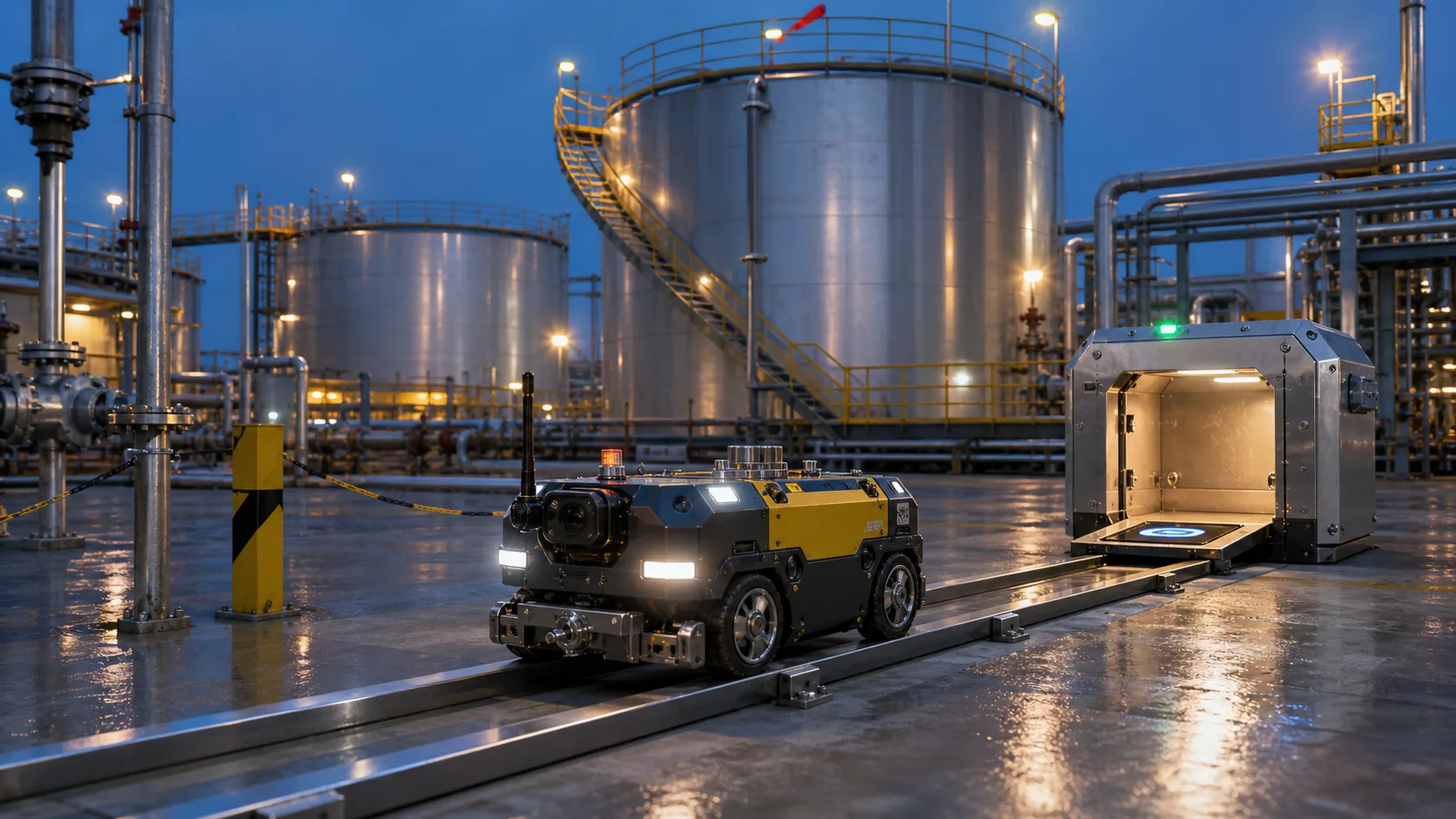
Unattended Wireless Charging for Explosion-proof Ground Rail Robots
Ground rail inspection robots can follow repeatable routes through industrial facilities while carrying cameras and environmental sensors. In hazardous areas, both the robot and its charging equipment must have the protection and approvals required for the actual atmosphere and installation.
Applications and route design
Potential applications include petrochemical tank farms, pipeline corridors, gas facilities and surface coal-handling galleries. A rail can provide a defined route, but its gradient, clearances, crossings and access for maintenance must be engineered for the site. Rail guidance does not automatically provide obstacle avoidance or unrestricted travel over uneven ground.
System components
A typical system includes the rail, mobile robot, sensors, control station, communications and charging station. Localization may combine encoders with reference markers such as RFID. Accuracy depends on the implementation and needs to be checked against the inspection and docking requirements.
- Sensing: Visible-light and thermal imaging, and suitable gas or smoke sensors where required.
- Analysis: Software can flag abnormal readings or images for investigation.
- Communications: Video, alarms and task status can be sent over a site-approved wired or wireless network.
Automatic wireless charging
A stationary transmitter couples to a receiver after the robot reaches the permitted charging position. Removing mating charging contacts can reduce contact wear and sparking during engagement. The charger, battery and control system must still manage temperature, electrical faults, communication loss and safe departure.
Battery runtime, charging efficiency and docking tolerance are model- and duty-cycle-specific. A protection marking such as Ex d IIC T4 Gb is not a generic wireless charging standard or proof of suitability for every gas, dust or mining application. Check the actual certificate, equipment marking and conditions of use.
Commissioning and maintenance
Validate rail installation, EMC, docking success, thermal performance and environmental protection under representative conditions. Inspect the charging pads, cabling and protection controls as part of the maintenance plan. Fleet or inspection software can then coordinate charging and task recovery using confirmed operating limits.