
Wireless Charging for Explosion-proof Robots in Hazardous Industries
In high-risk industrial scenarios such as petrochemicals, coal mines, power and gas, equipment operating environments often include flammable gases, explosion risks, heavy dust and high humidity. These conditions place very high requirements on the safety and reliability of inspection equipment. As an important carrier of intelligent inspection, explosion-proof robots’ power supply and charging methods are directly related to the safe operation of the overall system. Wireless charging technology provides a safer and more stable energy supply solution for explosion-proof robots.
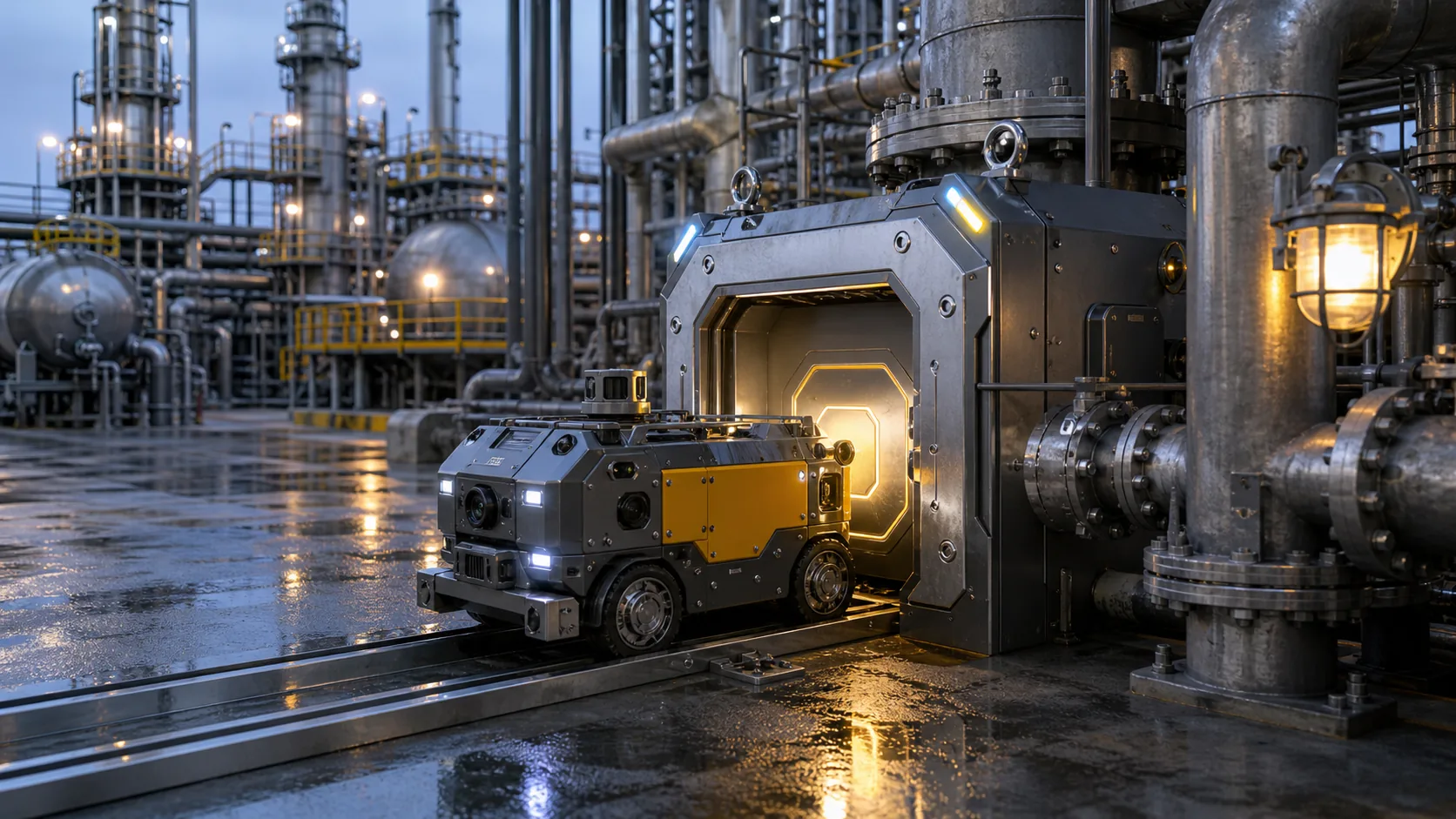
Special requirements for charging methods of explosion-proof robots
The traditional wired charging method relies on metal contact connections, which is prone to the following problems in explosion-proof environments:
- Electric sparks may be generated during plugging/unplugging.
- Exposed contacts, risk of oxidation, corrosion and dust accumulation
- Unstable contact in high humidity and highly corrosive environments
- Frequent mechanical contact leads to increased maintenance costs
Therefore, explosion-proof robots usually require charging systems No exposed contacts, low temperature rise, no sparks, strong structural sealing, wireless charging technology naturally complies with these safety design principles.
How wireless charging works in explosion-proof robots
Explosion-proof robot wireless charging systems generally implement energy transmission based on the principle of electromagnetic induction or magnetic resonance. By forming a non-contact energy coupling between the robot body and the charging base station, the safe transfer of electrical energy is achieved. The entire charging process does not require physical plugging/unplugging, and can be completed inside a sealed, explosion-proof structure.
The system usually includes the following parts:
- Explosion-proof wireless charging transmitter
- Robot wireless receiving module
- Explosion-proof power management and control unit
- Positioning and Alignment Auxiliary Structure
This structural design can effectively avoid the generation of arcs and sparks, and improve the operating safety level of the system in hazardous environments.
Technical advantages of wireless charging for explosion-proof robots
Improve intrinsic safety level
Wireless charging eliminates the exposed charging interface, greatly reducing safety hazards caused by poor contact or environmental factors, and is in line with the "intrinsically safe" design concept of explosion-proof equipment.
Adapt to complex industrial environments
Under harsh conditions such as high dust, high humidity, and corrosive gases, the wireless charging system can still maintain stable operation and reduce the impact of the environment on charging reliability.
Support automation and unattended
The explosion-proof robot can autonomously return to the charging area to recharge between tasks without manual intervention. It is suitable for long-term, continuous operation of intelligent inspection applications.
Reduce maintenance costs
Reduce mechanical wear and contact aging problems, extend the overall service life of the charging system, and reduce operation and maintenance frequency and maintenance costs.
Typical application scenarios
Explosion-proof robot wireless charging technology has been gradually applied to the following scenarios:
- Petrochemical plant area inspection
- Inspection of pipeline corridors in refineries and chemical plants
- Coal mine underground equipment inspection
- Safety inspection of gas stations and storage tank areas
- Dangerous goods storage and production area
In these scenarios, wireless charging technology effectively ensures the long-term, stable and safe operation of explosion-proof robots.
Summary
Explosion-proof robot wireless charging technology solves the potential safety hazards of traditional charging solutions in hazardous environments through non-contact energy transmission. It has significant advantages in improving the explosion-proof level, operational reliability and automation level, and has become an indispensable and important component of the explosion-proof inspection robot system. As industrial intelligence continues to improve, wireless charging technology will play a more critical role in the field of explosion-proof robots.