
Wireless Charging for Greenhouse Robots
Greenhouse robots are common mobile smart devices in smart agriculture and can be used for tasks such as crop inspection, environmental monitoring, fruit and vegetable picking, material transportation, spraying and plant protection, and data collection. As the scale of greenhouse cultivation expands, robots have gradually developed from auxiliary equipment to an important execution unit in the agricultural production automation system.
The interior of a greenhouse usually often has high humidity, significant temperature changes, possible floor water accumulation, and high frequency of operations. If the robot relies on manual cable plugging for charging, it will not only increase management costs, but also easily affect charging stability due to moisture, soil adhesion and frequent connector wear. Therefore, wireless charging is becoming an important charging method for greenhouse robots to achieve unattended operation.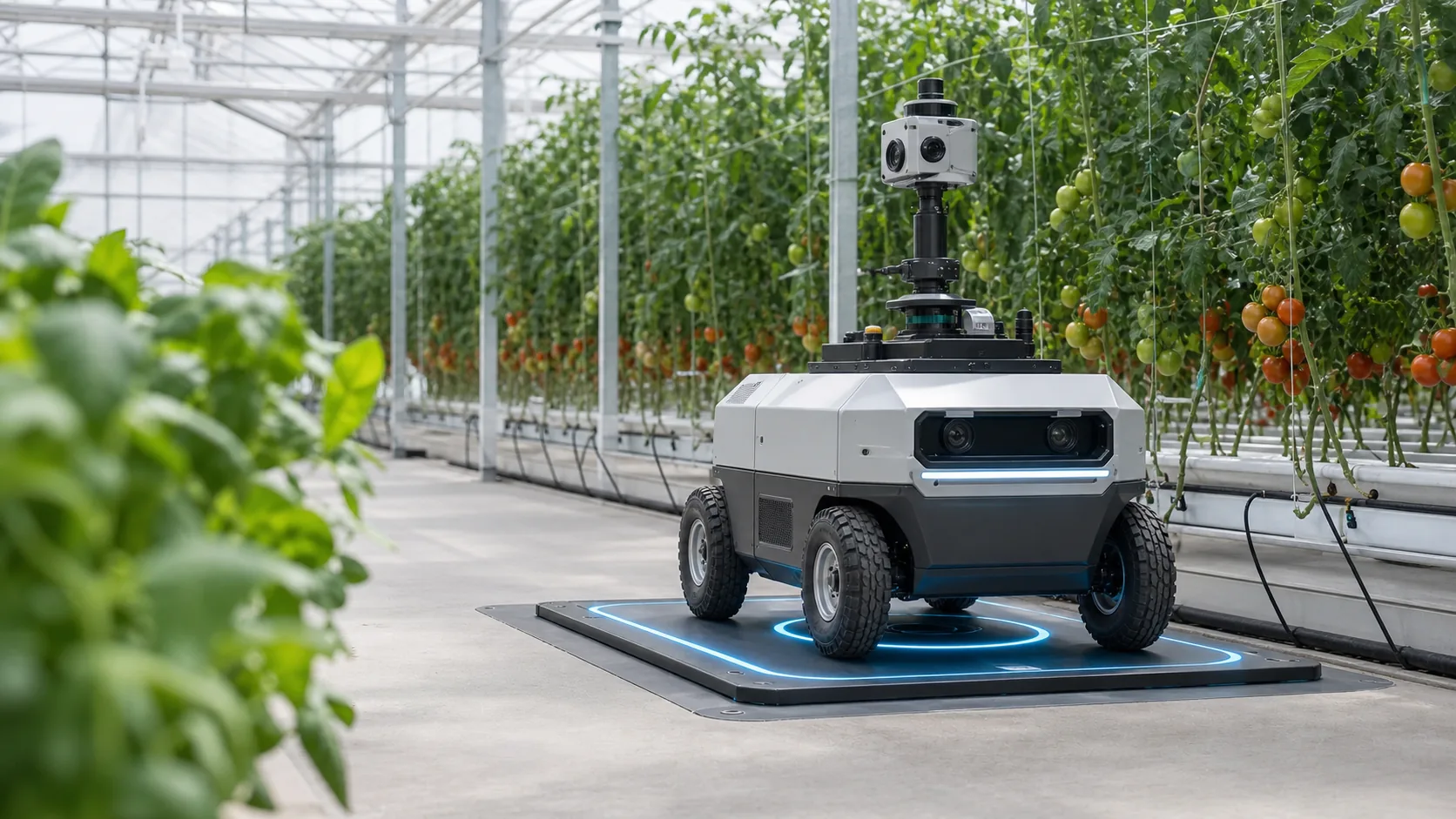
Why does the greenhouse robot need to be automatically charged?
Greenhouse production emphasizes continuity and stability. Robots often need to perform repeated inspections along fixed routes, or complete handling and monitoring tasks between different operating areas. If personnel are required to intervene every time the battery is low, it will be difficult for the entire smart agriculture system to be truly unattended.
The automatic charging system allows the robot to return to the charging point autonomously according to the battery status, and continue to perform tasks after charging. For greenhouse scenarios with multiple shifts and long-term operations, this closed-loop charging capability can significantly improve equipment utilization.
Advantages of wireless charging in greenhouse scenarios
- Reduce interface exposure: Non-contact charging reduces the exposure of metal contacts and reduces the impact of moisture, soil and fertilizer liquid on the interface.
- Reduce manual operations: The robot can dock at the charging station autonomously, eliminating frequent manual cable handling, making it suitable for large-scale greenhouse management.
- Improve operational continuity: Can be combined with the task scheduling system to automatically recharge when the battery is low or between tasks, reducing downtime waiting time.
- Adapt to complex environments: The humidity, temperature and ground conditions in the greenhouse change greatly, and the wireless charging structure is more conducive to waterproofing, dustproofing and long-term maintenance.
- Facilitates system integration: Wireless charging can be linked with BMS, power management, scheduling platform and charging status feedback to form a complete automatic charging process.
Applicable robot types
Greenhouse wireless charging can be applied to inspection robots, picking robots, transportation robots, spray robots, crop phenotype collection robots and multi-functional agricultural mobile platforms. These devices usually run on relatively fixed paths and have the conditions to set up fixed charging points or docking areas, making them very suitable for deploying wireless charging systems.
Key parameters for system design
When configuring a wireless charging solution for a greenhouse robot, the design should consider battery voltage, target power, chassis ground clearance, docking accuracy, working distance, protection level, heat dissipation method and communication interface. If the site involves cleaning, spraying or high humidity, priority should also be given to charging products with good waterproof capabilities and sealed structures.
In practical applications, wireless charging points can be arranged at the ends of greenhouse passages, task waiting areas, storage transfer areas or robot parking areas. After completing the task, the robot automatically returns to the charging point, confirms the docking status and charging status through the dispatching system, and enables automatic charging and task continuation.
Summary
For greenhouse robots to stably participate in smart agricultural production, a reliable automatic charging system is essential. Wireless charging can reduce manual intervention, reduce interface maintenance pressure, and improve the operation continuity of robots in humid and high-frequency operating environments. As agricultural robots and smart greenhouse systems continue to become more popular, Wireless charging for greenhouse robots will become an important basic configuration in the unattended operation of smart agriculture.