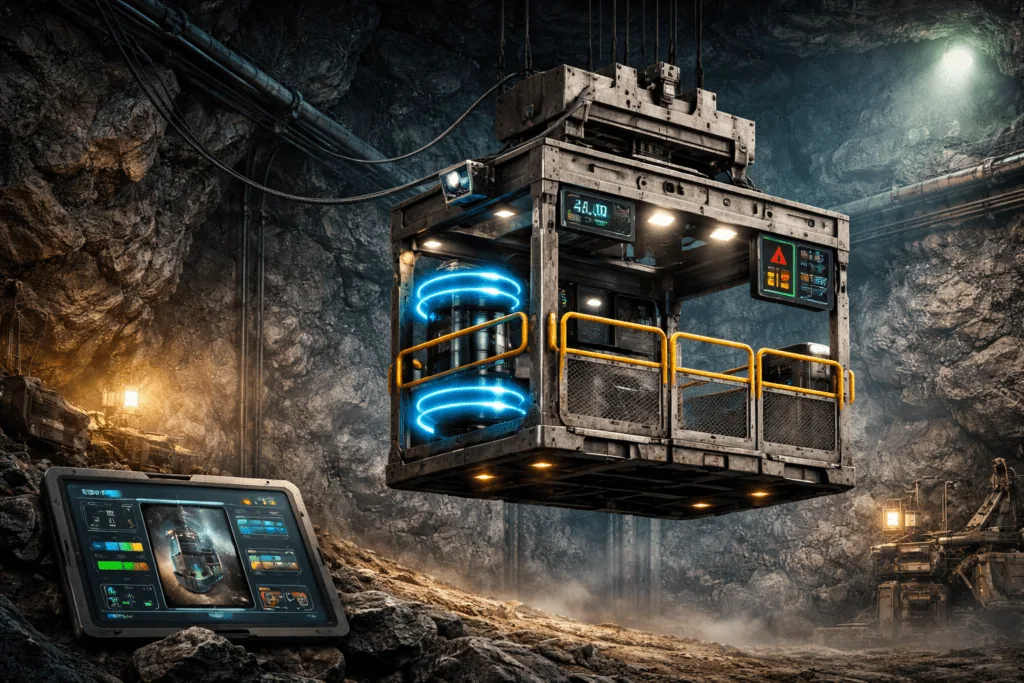
Wireless Charging for Intelligent Mine Cage Systems
An intelligent mine cage may carry low-voltage lighting, monitoring instruments, communications equipment and controls. An onboard battery can supply those auxiliary loads while the cage moves, with automatic charging at a designated stopping point.
Charging arrangement
A fixed transmitter at a landing or shaft-head station couples to a receiver on the cage after the cage has stopped in the permitted position. The charging controller checks readiness and battery conditions before enabling power transfer. Charging stops before departure or on a defined fault, and the battery continues to supply the auxiliary equipment.
This arrangement concerns onboard auxiliary power; it does not supply the hoist drive or remove the need for the mine's independent safety systems.
Coordinate the auxiliary loads
- Control equipment: Cage-door and wagon-retention controls, where included in the approved system design.
- Communications: Monitoring and data exchange with different mine levels.
- Monitoring: Instruments for the cage and associated hoisting equipment.
- Lighting: Low-voltage lighting matched to the battery and site requirements.
Specify performance from the duty cycle
List the loads and their operating times, calculate the energy used between charging stops, and allow for battery limits and reserve capacity. Select charging power from the available dwell time. The 600 W and 1,200 W options mentioned in the original proposal are design options to evaluate, not confirmed specifications for every cage.
Efficiency, charging time, runtime, temperature range and IP rating must be supported by the selected model's documentation and tests. A general claim such as “40 minutes of charging for ten hours of operation” cannot be applied without the battery capacity, connected loads and test conditions.
Protection and maintenance
Contactless transfer avoids mating electrical charging contacts, but does not eliminate all ignition hazards or all maintenance. Check the complete installation's protection, thermal behavior, fault shutdown and relevant mine approvals.
Gas-group II or dust-group III markings are not themselves proof of approval for an underground mine application requiring Group I equipment. Check the actual certificate and conditions of use rather than presenting a generic Ex marking as a mining certification.
Inspect pads, wiring, mounting and controls, and monitor charging status and battery condition. Integration with the mine's monitoring platform can help staff track missed charge sessions and investigate faults.