
Wireless Charging for Mobile Manipulator Robots
With the continuous development of smart manufacturing, smart logistics and special inspection scenarios, hybrid robots are gradually becoming core equipment in complex industrial environments because of their integrated multiple motion and operating capabilities. At the same time, the limitations of traditional wired charging methods in terms of reliability, safety and automation have become increasingly obvious, and wireless charging technology has begun to become an important supporting solution for hybrid robots.
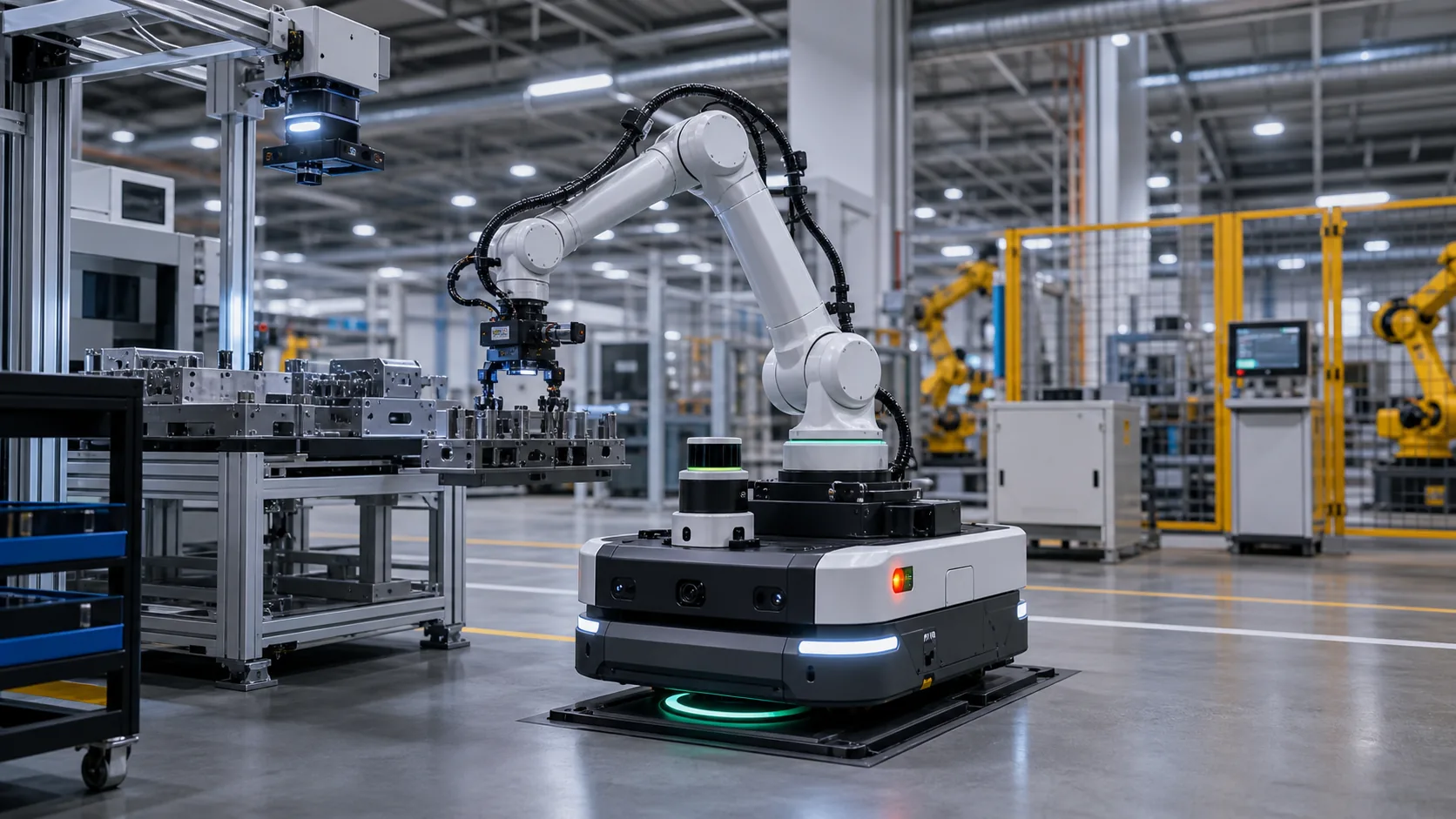
Characteristics and charging challenges of hybrid robots
Compound robots usually integrate multiple functional forms, such as mobile chassis and robotic arms, inspection and operation units, visual recognition and sensing systems, etc., and have the following typical characteristics:
- Complex structure and high equipment integration
- The working environment is diverse and may contain dust, moisture or corrosive factors
- Long operating cycle, high requirements on battery life and reliability
- High degree of automation and high cost of manual intervention
Against this background, plug-in charging interfaces are prone to problems such as poor contact, wear and aging, or insufficient protection levels, and are no longer able to meet the long-term stable operation needs of hybrid robots.
Advantages of wireless charging in hybrid robots
Wireless charging technology is based on the principle of electromagnetic coupling or magnetic resonance, which can enable power transmission without physical contact, bringing many advantages to hybrid robots:
1. Improve system reliability
Mechanical contacts are eliminated to avoid charging failures caused by oxidation, water ingress, and dust accumulation, significantly reducing the failure rate.
2. Support highly automated operation
The robot can complete alignment and charging independently without manual cable plugging, and is suitable for unattended or closed environments.
3. Adapt to complex and harsh working conditions
The wireless charging system is easy to implement high protection level design and is suitable for industrial workshops, tunnels, mining areas, energy facilities and other scenarios.
4. Compatible with composite structural design
The charging end and receiving end can be flexibly laid out and are not restricted by the shape and motion structure of the robot, making system integration easier.
Typical application scenarios
Composite robot wireless charging has practical application value in many fields, including but not limited to:
- Inspection and operation hybrid robot in factory workshop
- Mobile operation integrated robot in warehousing and logistics
- Inspection and maintenance composite robots in power and energy facilities
- Explosion-proof or confined space operating robots in special environments
In these scenarios, wireless charging not only improves system stability, but also provides a basic guarantee for the robot to operate around the clock.
Technology development trends
In the future, composite robot wireless charging technology will show the following development directions:
- Evolving towards higher power and higher efficiency
- Support larger alignment deviation and improve charging fault tolerance
- Deeply integrated with the robot scheduling system to achieve intelligent charging management
- Meet more stringent industrial safety and explosion protection standards
Wireless charging technology is becoming an indispensable part of hybrid robots. By eliminating the risks caused by physical connections, wireless charging not only improves the safety and reliability of the system, but also lays a solid foundation for the large-scale deployment of composite robots in complex industrial and special application scenarios.