
Non-contact Charging Conveyor Belt Inspection Robots for Mines
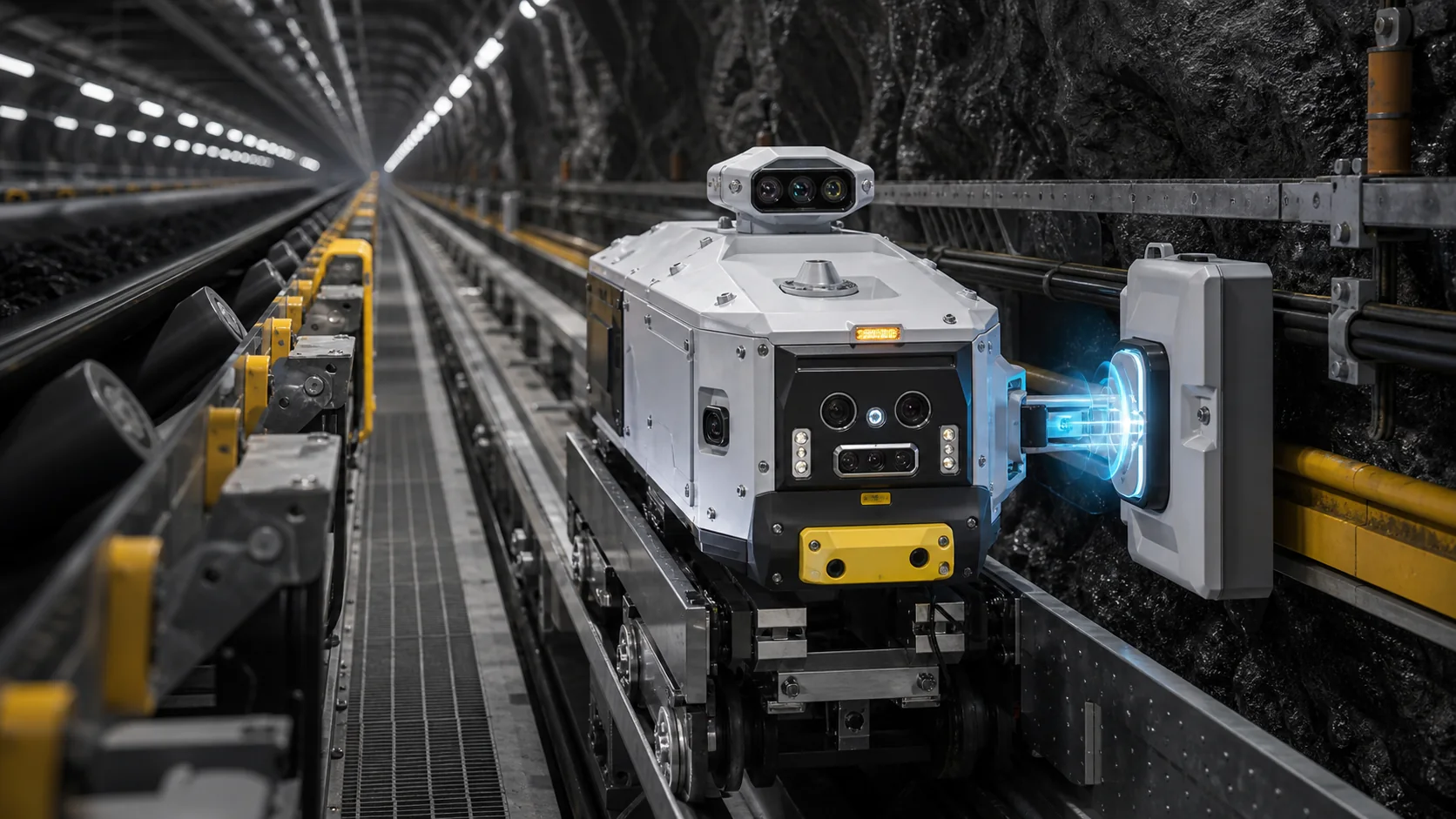
Main belt conveyors in coal mines have long routes, long operating hours, and scattered fault points. Manual inspection has long faced problems such as high intensity, low efficiency, and prominent safety hazards. The Mengda Mining application case uses mine non-contact charging conveyor belt inspection robots, integrating a multi-wheel rail system, magnetic coupling wireless charging, edge computing AI and multi-parameter environmental monitoring into the same system, and provides a more complete engineering model for unattended inspection of the main transport belt.
1. Why does the main transport belt need a non-contact charging inspection robot?
The main belt conveyor is key equipment for coal mine production and transportation. Once deviation, tearing, foreign-object blockage, roller overheating, smoke or harmful gas abnormalities occur, it can easily cause shutdowns or even safety accidents. It is difficult for traditional manual inspections to achieve high-frequency, continuous, and standardized records, and it is also difficult to identify abnormalities and trigger linked responses in time.
- Inspection route length: The main transport belt route is long, and the manual round-trip inspection is time-consuming;
- High environmental risk: There are coal dust, moisture, gas, noise and low-light conditions underground;
- Many fault types: Deviation, foreign matter, temperature rise, smoke, gas, etc. require multi-sensor judgment;
- Charging is inconvenient: Contact charging contacts are prone to dust, oxidation, and wear, and require high maintenance pressure.
2. What modules does the system consist of?
According to relevant application cases in "Smart Mine", the non-contact charging inspection robot system consists of the robot body, multi-wheel rail system, magnetic coupling charging, edge computing AI and other modules. It is not a single camera inspection, but a closed-loop system that combines visual recognition, environment perception, mobile platform and automatic charging.
| Module | Function |
| Robot body | Equipped with camera, thermal imaging, environmental sensing, control and communication units |
| Multi-wheel rail system | Stable operation along the conveyor belt route, suitable for long-distance inspections |
| Magnetic coupling wireless charging | Enable non-contact charging, reducing contact wear and manual cable plugging |
| Edge computing AI | Locally identify deviations, foreign objects, smoke and other anomalies to improve response speed |
| Multi-parameter monitoring | Real-time monitoring of methane, CO, smoke and other safety parameters |
3. Engineering value of non-contact wireless charging
In the explosion-proof scenario of coal mines, the charging method should not only consider "whether it can be charged", but also consider the risk of sparks, the impact of dust, the frequency of maintenance and the ability of the robot to operate autonomously. Non-contact wireless charging uses magnetic coupling to transmit energy. After the robot reaches the charging position, it can automatically recharge without mechanical plugging/unplugging. It is more suitable for underground fixed track inspection systems.
- Reduce contact failures: No exposed electrodes to avoid poor contact caused by coal dust and moisture.
- Improve safety: Non-contact charging can reduce the risk of sparks and mechanical wear during plugging/unplugging.
- Support unattended: The robot can automatically inspect, automatically return to the station, and automatically charge according to tasks.
- Suitable for long-distance inspections: In the case, the robot has an operating range of more than 20 km, which can cover the long-distance inspection needs of the main transport belt.
4. AI recognition and multi-parameter monitoring make inspections more specific
This type of conveyor belt inspection robot does more than capture and transmit images, but puts AI recognition and multi-parameter monitoring on the robot itself. It is mentioned in the case that the system has an adaptive lifting capability of 0~1800 mm and can adapt to different inspection heights; belt deviation detection reaches 7 cm-level; the foreign object recognition rate is greater than 91%; and it can also perform real-time monitoring of parameters such as methane, CO, and smoke.
| Capability | Application value |
| 0~1800 mm adaptive lifting | Adapt to inspection points at different heights of belt conveyors |
| 7 cm-level belt deviation detection | Detect conveyor belt drift trends earlier |
| Foreign object recognition rate>91% | Reduce the risk of foreign-object blockage and belt damage |
| Methane/CO/Smoke Monitoring | Integrate equipment inspections with environmental safety monitoring |
| Edge AI Analysis | It can still perform local analysis and operate independently when communication fluctuates. |
5. What does the on-site result show?
A 10-month industrial test at Mengda Mining showed that staffing for inspection was reduced from 5-6 people per shift to 1-2 people, the inspection efficiency increased by more than 50%, and abnormal downtime was also significantly reduced. This shows that the non-contact charging conveyor belt inspection robot is not just a single equipment upgrade, but integrates "inspection, identification, communication, charging, and alarm" into a system that can operate continuously.
It is worth noting that the ring network or 5G is interrupted, the robot can still operate independently. This is very important for long-distance belt tunnels underground: when communication is unstable, the robot can still complete local data collection, anomaly identification and task execution, and then complete data return or alarm synchronization after communication is restored.
6. Design suggestions for non-contact charging system
- Charging point layout: Prioritize placement at the end of the track, safety chamber or dispatch waiting area;
- Explosion proof and protection: The transmitter, receiver and power module should confirm the explosion-proof, dust-proof and waterproof requirements according to the underground environment;
- Alignment tolerance: Track parking accuracy, charging distance and lateral offset range need to match;
- Communication linkage: The charging status should be connected to the robot control system and mine dispatching platform;
- Fail-safe protection: Over-temperature, over-voltage, over-current, foreign object detection and charging abnormality alarms must be retained.
Conclusion
The non-contact charging conveyor belt inspection robot for mining advances the main conveyor belt inspection from manual high-intensity inspection to the stage of continuous robot sensing and automatic charging. Wireless charging solves the problem of "whether the robot can stay on site for a long time to work", while edge AI and multi-parameter monitoring solve the problem of "whether the robot can detect problems in time". The combination of the two is the real direction for the intelligent operation and maintenance of the coal mine's main transport system.
Reference materials: Li Xiaolin, Yong Shengmin, Liu Hui, et al. "Application of Mining Non-contact Charging Conveyor Belt Inspection Robot in Mengda Mining", "Intelligent Mining", Volume 6, Issue 12, 2025, pages 59-63.