
Wireless Charging for Mine Skip Hoist Systems
As mine hoisting systems move toward intelligent operation and lower manpower, the skip is no longer just a mechanical container for hoisting ore. Equipment such as camera monitoring, weighing detection, position identification, vibration collection, communication transmission, and edge computing are entering the skip lifting scenario. This equipment requires stable, safe, and maintainable low-voltage power supplies. mine skip wireless charging The value lies in providing automatic charging capabilities for these accompanying smart devices without adding manual cable plugging or exposed contacts.
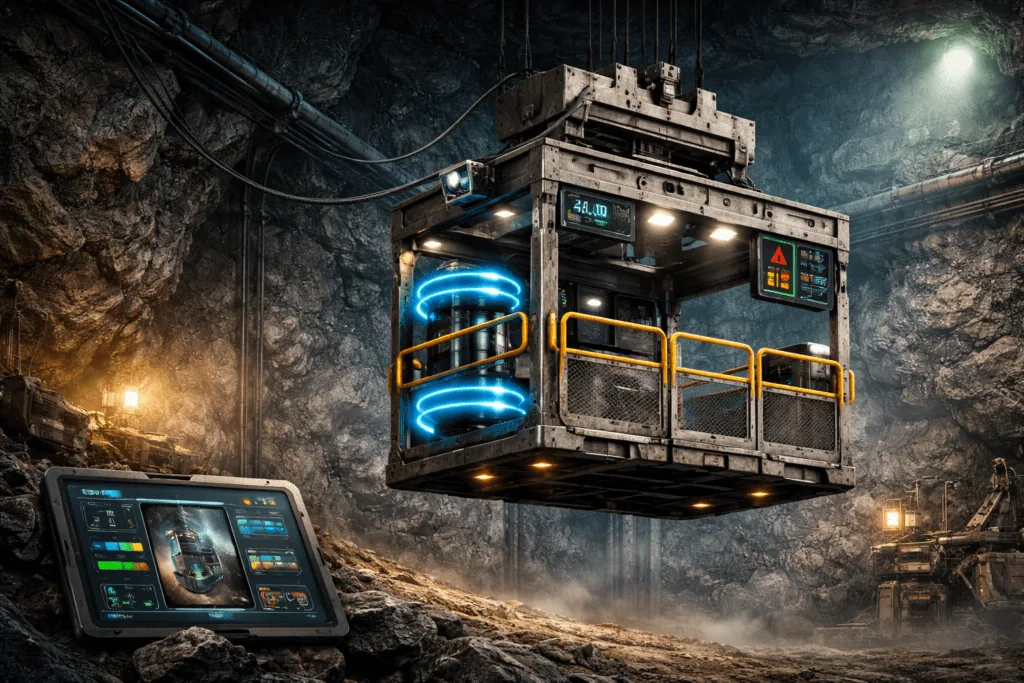
China Coal Industry Knowledge Service Platform’s report on the application of intelligent skip lifting at Shandong Gold Linglong Gold Mine reflects that mining lifting equipment is moving from simple mechanical control to data-based and intelligent. For such scenarios, the power supply system also needs to be upgraded simultaneously: it must not only be able to supply power, but also adapt to the working conditions of wet, dusty, vibration and high-frequency stops in the wellbore.
1. Why does skipping need wireless charging?
The electrical equipment of the traditional skip hoisting system is mostly concentrated at the wellhead, bottom or hoisting machine room, and there are fewer electrical equipment on the skip body. However, when intelligent detection and remote monitoring are added to the system, the number of accompanying devices will increase significantly. Common requirements include:
- Collection of skip operating status, position, speed and vibration data;
- Video, lighting, material level and weighing detection during loading and unloading;
- Data communication and status confirmation between the wellhead, well bottom and skip;
- Power supply for low-voltage control units such as door locks, limits, alarms, and sensors;
- Continuously online data required for smart diagnostic systems.
If you continue to rely on towing cables, sliding contact lines or manual plugging, it will easily lead to problems such as wear, poor contact, moisture corrosion, and frequent maintenance. The more complex the underground environment, the greater the maintenance pressure of contact power supply. Wireless charging uses non-contact energy transmission and does not require exposed metal contacts, making it more suitable for long-term operation and unattended mine lifting scenarios.
2. Typical application methods of skip wireless charging
In the skip hoisting system, wireless charging usually does not require full power supply. Instead, charging is completed during the window when the skip is docked and waiting for loading or unloading. The system can arrange wireless charging transmitters at the wellhead, bottom or intermediate stops, and receivers on the skip or accompanying power box. When the skip is in place, the control system confirms the position, the transmitter and receiver establish communication and start charging.
- identification in place: After the skip enters the docking area, the charging conditions are confirmed through position limit, positioning or communication signals.
- wireless handshake: The transmitter and receiver confirm voltage, current, temperature and battery status.
- Automatic replenishment: The system charges the energy storage battery or power module according to the set power.
- status return: Charging voltage, current, fault, temperature and other data are uploaded to the lifting control or mine dispatching platform.
- Off-site power outage: The skip automatically stops output before leaving the charging area to avoid malfunctions and energy waste.
3. The synergistic value with the artificial intelligence skip lifting system
After artificial intelligence technology enters the field of skip improvement, the key is not only the algorithm itself, but also whether the data can be collected stably, whether the equipment can be online for a long time, and whether abnormalities can be uploaded in time. Wireless charging can provide continuous charging for intelligent sensing units, allowing sensors, cameras and communication modules to maintain stable operation over multiple shifts.
The value of this type of synergy is mainly reflected in three aspects: first, ensuring that intelligent detection equipment is not powered on and reducing data gaps; second, incorporating charging status into equipment health management to facilitate early detection of battery aging, abnormal temperature rise or alignment abnormalities; third, reducing the frequency of manual maintenance, so that the intelligence of the system is not hindered by the power supply method.
4. Comparison between wireless charging and traditional power supply methods
| Compare items | Streamer/contact power supply | mine skip wireless charging |
| security | There is a risk of contact wear, moisture corrosion and contact sparks | No exposed electrodes, non-contact charging, suitable for complex mining environments |
| Maintenance amount | Cables, plugs, and sliding parts need to be inspected and replaced regularly. | Reduce mechanical wear points and make daily maintenance easier |
| degree of automation | Some scenarios require manual cable plugging or manual inspection and confirmation. | Automatically starts after reaching the position, supporting unattended charging |
| environmental adaptability | Significantly affected by dust, moisture, and vibration | Can be designed to be waterproof, dustproof, explosion-proof and wide temperature |
| Data capabilities | Power supply and status data are often scattered | Charging status and device health data can be uploaded simultaneously |
5. Key points that need attention in engineering design
Mine skip wireless charging is not simply to install the charging board next to the device, but to design the system based on the improvement of the cycle time, docking accuracy, installation space and mine safety requirements. It is recommended to focus on the following contents when making actual selection:
- Power and Recharge Window: Determine the charging power based on each docking time, power consumption of electrical equipment and energy storage capacity.
- Installation distance and offset range: There are vibrations and positioning errors in the operation of the skip. Reasonable tolerances must be maintained between the transmitting end and the receiving end.
- Protection level: The underground is humid and dusty, so IP65, IP67 and shell sealing structure should be considered.
- Explosion-proof requirements: When involving coal mines, metal mines or flammable and explosive environments, the explosion-proof level needs to be confirmed according to project requirements.
- Communication interface: Can be linked with the lifting control system, BMS or dispatching platform through RS485, CAN and other interfaces.
- Fail-safe protection: Should have over-temperature, over-voltage, over-current, foreign object detection, communication abnormality and charging status indication.
6. Direction of wireless charging solution suitable for skip scene
From the perspective of application logic, skip wireless charging has similarities with smart cages, mine inspection robots, and underground mobile equipment charging. They all emphasize non-contact, environmental resistance, low maintenance, and automation. Depending on the number of electrical equipment and docking time, small and medium-power wireless charging solutions such as 600W, 900W, and 1200W can be selected. Customized designs can also be made based on energy storage capacity and installation structure.
For skips that only provide power for sensors, lighting, communications and a small number of control devices, the focus should be on stability and protection levels; for systems that need to drive more actuators or edge computing devices, battery capacity, heat dissipation, charging time and communication linkage need to be evaluated simultaneously.
Conclusion
The intelligence of the skip hoisting system will ultimately fall into practical indicators such as "long-term online equipment, stable data transmission, less maintenance, and safer operation." Wireless charging is not a separate function, but a basic charging link in the intelligent skip lifting system. It allows sensors, communications, lighting and control equipment to get rid of manual plugging and contact maintenance, laying a more stable foundation for unattended and intelligent operation and maintenance of mine hoisting systems.
References: Related reports on China Coal Industry Knowledge Service Platform.