
Wireless Charging for Livestock Farming Robots
Livestock farming robots are an important part of modern farm automation. They can perform inspection, feeding, cleaning and disinfection, environmental monitoring, health assessment and data collection in cattle, pig, sheep and poultry facilities. As farms grow and labor costs rise, these robots support more frequent, consistent and precise on-site management.
Livestock facilities often have high humidity, dust, corrosive waste, uneven floors and long operating cycles. Manual cable charging increases maintenance work and can become unreliable when connectors are contaminated, oxidized or mechanically worn. With wireless charging, livestock farming robots can recharge automatically at fixed docking points with less human intervention.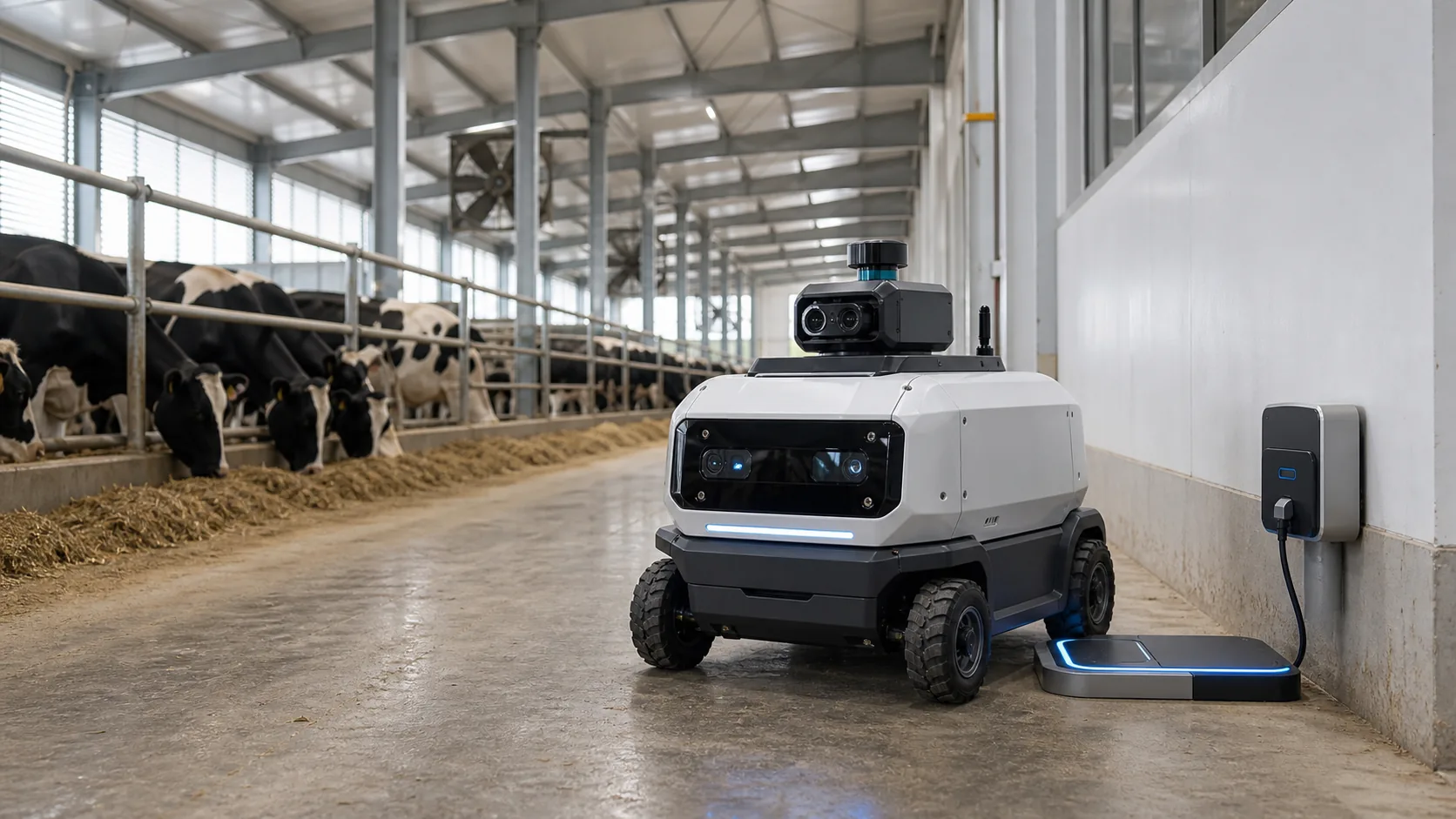
Why do livestock farming robots need automatic charging?
In large-scale farms, robots often need to perform repeated inspections along fixed routes, or complete feeding, cleaning and disinfection tasks between different stalls. The task frequency is high and the operating time is long. If each charge requires manual processing, it will be difficult for the robot system to be truly unattended.
The automatic charging system allows the robot to return to the charging point autonomously according to the battery status, and continue to perform tasks after charging. Wireless charging does not require exposed plugs and frequent plugging/unplugging, and is more suitable for livestock environments with a lot of moisture, dust and corrosive gases.
Advantages of wireless charging in farms
- Reduce manual cable plugging: The robot automatically docks at the charging station, eliminating the need for staff to frequently enter the pen for operation.
- Adapt to wet and corrosive environments: The non-contact structure reduces the exposure of metal interfaces and reduces the impact of water vapor, dust, feces and disinfectant on the interfaces.
- Reduce maintenance costs: Reduce plugging wear and poor contact, and improve the long-term stability of the charging system.
- Improve continuous operation capabilities: Can be combined with the task scheduling system to automatically recharge when the battery is low or between tasks, reducing downtime and waiting.
- Easy to integrate within the pen: Small and low charging stations can be arranged at the end of passages, parking areas or equipment rooms without affecting daily traffic and cleaning operations.
Applicable robot types
Wireless charging for livestock farming robots can be applied to inspection robots, feeding robots, cleaning and disinfection robots, manure removal robots, weighing and sorting robots and environmental monitoring robots. These devices usually have fixed routes or regular stops, making them suitable for autonomous charging stations.
Key parameters for system design
When configuring a wireless charging system for a livestock farming robot, the design should account for chassis height, battery voltage, target power, docking accuracy, charging distance, aisle width, protection rating, communication interface and cleaning methods. In humid or corrosive locations such as cattle and pig barns, the transmitter and receiver require suitable sealing, waterproofing, dust protection, corrosion resistance and heat dissipation.
In practical applications, it is recommended to link the wireless charging system with the robot dispatching platform, BMS battery management system and charging status feedback signal. The robot can automatically determine the battery level, plan a recharging route, complete docking and alignment, and continue to perform inspection, feeding or cleaning tasks after charging is completed.
Summary
Livestock farming robots need reliable automatic charging to operate consistently over long periods. Wireless charging reduces connector maintenance and manual handling while improving continuous operation in wet, dusty and corrosive environments. As large-scale farming moves toward automation and digital management, wireless charging for livestock farming robots will become an important part of the supporting infrastructure.