
Wireless Charging for Tomato Picking Robots
Tomato picking robots are representative agricultural robots in smart greenhouses. It usually integrates visual recognition, robotic arms, end clamps, mobile chassis and job scheduling systems, which can reduce manual input in tomato ripeness identification, fruit positioning, automatic picking, transportation and data collection.
Tomato greenhouse operations are characterized by high frequency, relatively fixed routes, narrow space, and high humidity. If the picking robot relies on manual cable plugging to recharge, it will affect the continuous operation efficiency, and it is also prone to unstable charging due to moisture, dust and mechanical wear of the interface. Introducing wireless charging into a tomato picking robot system helps the robot dock autonomously between tasks and recharge automatically at compact charging stations.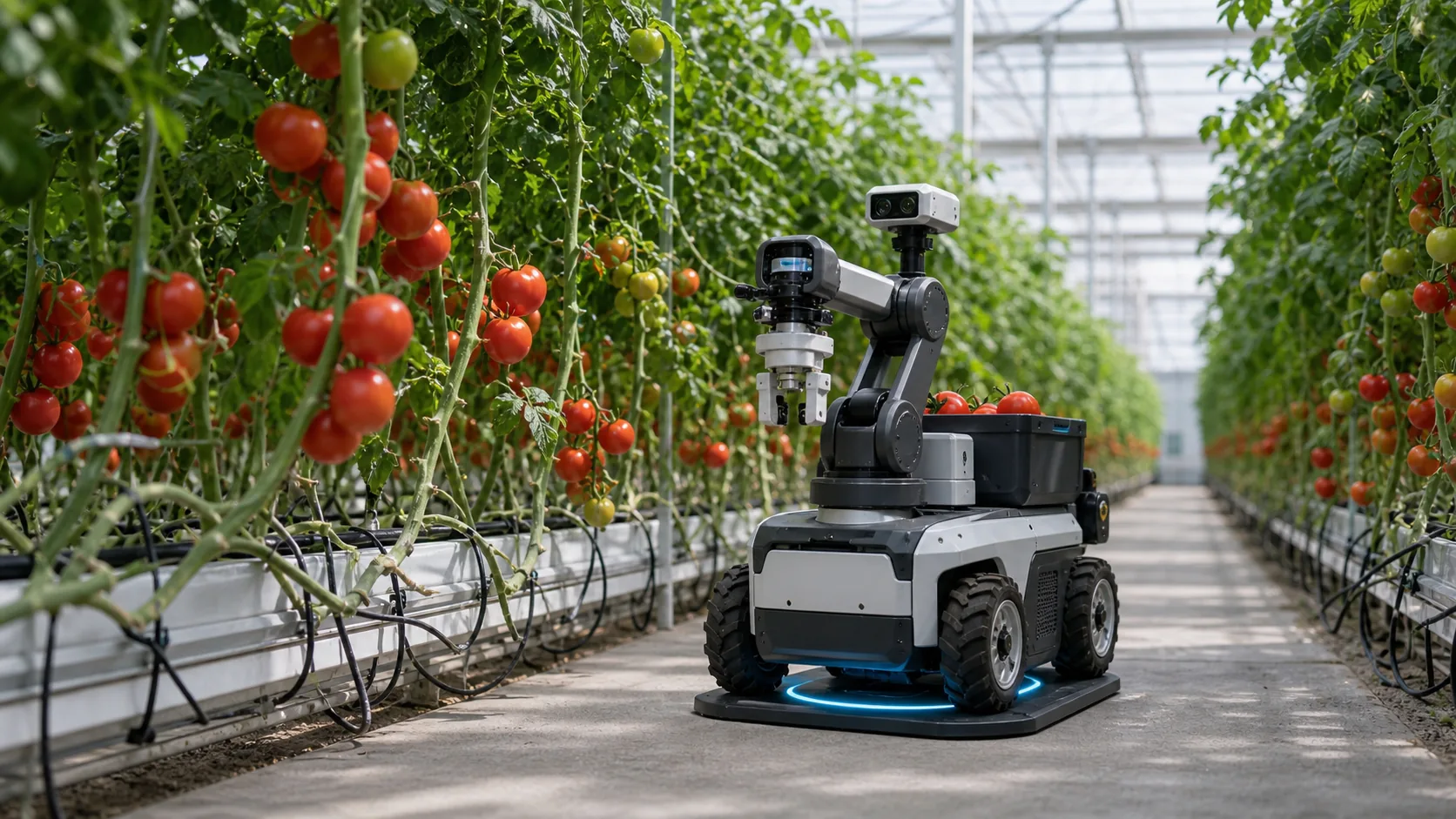
Why does a tomato picking robot need wireless charging?
Tomato picking tasks are often not completed in one go, but are carried out in batches and continuously as the fruit matures. The robot needs to move repeatedly between greenhouse rows to perform actions such as identification, grabbing, placement and transfer. If power management relies on manual processing, it will interrupt the automated process and reduce equipment utilization.
Wireless charging allows the picking robot to automatically return to the charging point when the battery is low, the task is completed, or waiting for dispatch. The charging pad can be designed as a low-profile, compact, embedded or floor-mounted unit, taking up little space and not affecting greenhouse passages and work routes.
Core advantages of wireless charging
- Reduce manual cable plugging: The robot can dock and charge independently, reducing the need for people to enter the greenhouse for frequent operations.
- Adapt to high humidity environment: The non-contact structure reduces the exposure of metal interfaces and reduces the impact of moisture, soil and nutrient solutions on the charging interface.
- Reduce maintenance costs: There is no interface wear caused by repeated plugging/unplugging, suitable for agricultural robots with high frequency operations.
- Improve continuous operating capability: Can be combined with the robot scheduling system to automatically recharge between picking tasks and reduce downtime waiting time.
- Convenient for small space deployment: The small and low charging board can be placed at the end of the aisle, in the transfer area or at the robot standby point, without occupying a large area of working space.
Where is it suitable for deployment?
In the tomato greenhouse, wireless charging points can be arranged at the end of the working channel, the picking basket transfer point, the robot parking area or the dispatch waiting area. For scenarios where multiple robots work together, multiple charging points can also be set up according to route planning, so that the robots can complete short-term charging in different areas.
Key parameters for system design
The wireless charging solution for tomato picking robots needs to be designed based on chassis height, battery voltage, target charging power, parking accuracy, charging distance, channel width, protection level and communication interface. In a greenhouse environment, attention should also be paid to waterproofing, dustproofing, heat dissipation and corrosion resistance of the shell to avoid long-term high humidity environment affecting the system life.
If the robot is equipped with a robotic arm and vision system, it is recommended to link the wireless charging system with the BMS, power management, scheduling system and charging status feedback. The robot can automatically recharge when the battery is low, and continue to perform picking or transport tasks after charging is completed.
Summary
For tomato picking robots to operate efficiently, continuously, and with low manual involvement in greenhouses, the ability to automatically recharge is very important. Wireless charging can reduce manual intervention and interface maintenance pressure through non-contact, miniaturization and automatic docking to recharge, and improve the reliability of agricultural robots in high-humidity and high-frequency operating environments. With the large-scale application of smart greenhouses and agricultural robots, Wireless charging for tomato picking robots will become a practical configuration in smart agricultural systems.