
Wireless Charging for Underground Belt Conveyor Inspection Robots
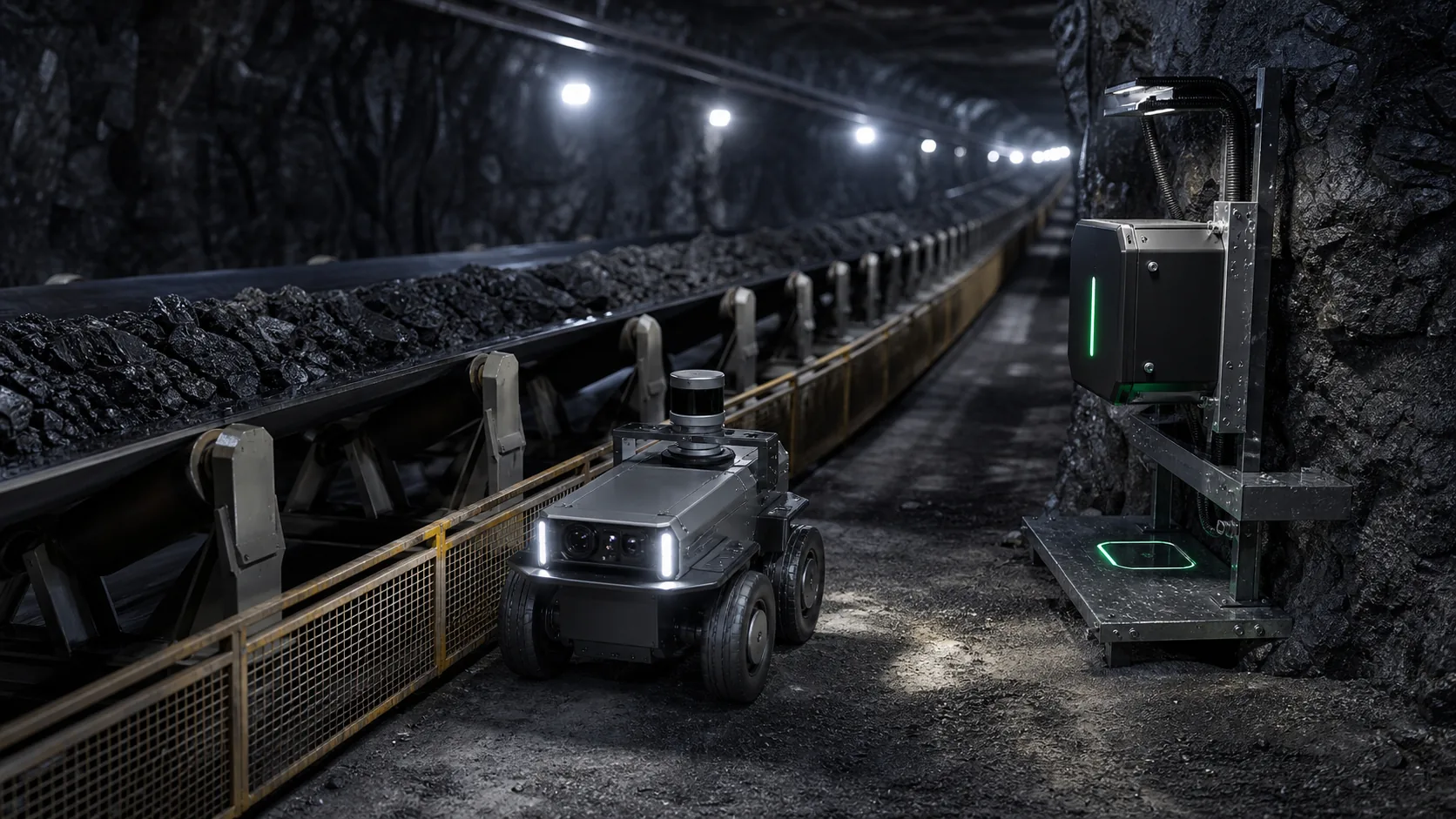
The underground belt conveyor in coal mines is responsible for the transportation of raw coal. It has long operating hours, long route distance and many inspection points. Traditional manual inspections are prone to problems such as low efficiency, data lag, and high personnel risks. In response to this scenario, orbital intelligent inspection robots have gradually become an important equipment for intelligent operation and maintenance of belt transportation lanes, and wireless charging is a key charging method for long-term online inspection of robots.
1. Why do we need robots for belt conveyor inspection?
Belt conveyor inspection is not simply about looking around the equipment. The underground belt tunnel involves many types of information such as rollers, rollers, motors, reducers, belt deviation, smoke, temperature rise, coal piles, tears, abnormal noise and environmental safety. Manual inspections are affected by route length, noise, dust, lighting and personnel status, and it is difficult to achieve continuous, real-time and standardized data.
- Inspection distance is long: The belt transportation line is arranged continuously, and the manual round-trip inspection takes a lot of time;
- Dispersion of risk points: Abnormalities such as smoke, temperature rise, deviation, and coal scattering may appear in different locations;
- Data lag: Manual recording is difficult to achieve second-level alarms and real-time backhaul;
- Complex environment: Coal dust, moisture, vibration and noise will increase the difficulty of inspection.
2. System composition of the orbital inspection robot
Sun Xupeng proposed in "Research on Inspection Robot System for Underground Belt Conveyors in Coal Mines" that the system is based on the integration of "sensing-transmission-calculation-control-display" and multi-source sensing fusion method, integrating AI image recognition, infrared thermal imaging, multi-source environment perception, positioning and industrial communication capabilities.
| system module | Main function |
| AI image recognition | Identify visual anomalies such as deviations, coal scattering, foreign objects, intrusions, etc. |
| Infrared thermal imaging | Monitor abnormal temperature rise of rollers, drums, motors, reducers, etc. |
| Multi-source environment awareness | Collect environmental information such as smoke, temperature, humidity, and gas |
| RFID/Beidou positioning | Realize robot inspection location identification and abnormal point positioning |
| Industrial ring network communication | Complete data backhaul through 10G industrial ring network in collaboration with Wi-Fi 6/5G |
| wireless charging | Support robots to autonomously return to the station to recharge and reduce manual maintenance. |
3. The role of wireless charging in belt inspection
Belt inspection robots usually run along fixed tracks with clear routes and stable stopping points, making them very suitable for arranging fixed wireless charging stations. The robot can automatically return to the charging position when the task is completed, the battery is low, or the schedule is idle, and the energy can be replenished through a non-contact method.
- The robot conducts autonomous, fixed-point or remote-controlled inspections according to the set route;
- Upload alarms in real time when abnormalities such as smoke, temperature rise, deviation, etc. are discovered;
- Return to the wireless charging station when the inspection is completed or the battery is low;
- The system completes position recognition, communication handshake and automatic charging;
- The charging status is synchronously uploaded to the inspection platform to facilitate unified management.
4. Advantages of wireless charging compared to contact charging
The underground belt tunnel has a lot of coal dust and high humidity, and the contact charging contacts are prone to dust accumulation, oxidation, wear and poor contact. Wireless charging does not have exposed electrodes and mechanical plug-and-pull actions, and is more suitable for long-term operation of fixed-track inspection robots.
| Compare items | contact charging | wireless charging |
| security | There are potential risks of sparks and leakage in the plug-in contacts | Contactless transmission, no exposed electrodes |
| Maintenance amount | Contacts need cleaning, adjustment and replacement | No mechanical wear and low maintenance |
| environmental adaptability | Dust and moisture can easily affect contact quality | Can be made into sealed waterproof and dustproof structure |
| automation | High alignment requirements and exceptions require manual handling | Allow a certain offset to facilitate autonomous recharging |
| Platform linkage | Charging status collection is relatively scattered | Can be connected to BMS, robot controller and inspection platform |
5. Enlightenment of thesis test data on engineering applications
The study was tested in a 150 m simulated tunnel. The single inspection time was 7.6 minutes, while the manual inspection was about 21 minutes; the response time to smoke and abnormal temperature rise alarms was 2-3 s; the data upload success rate was greater than 98%; the positioning error was ±0.4 m; and the ZigBee packet loss rate was less than 4%. These data show that orbital inspection robots can not only improve inspection efficiency, but also move abnormal identification and alarms from "post-event recording" to "real-time response."
For wireless charging solutions, fixed tracks and fixed charging points make system integration more controllable. As long as the robot positioning accuracy, charging plate installation distance, lateral offset range and communication linkage design are reasonable, a closed loop of "inspection-alarm-recharging-reinspection" can be formed.
6. System design suggestions
- Charging station location: Prioritize placement at the end of the track, maintenance chamber or dispatch waiting area;
- Protection level: The transmitting end and receiving end should consider coal dust, moisture and flushing environment;
- Power selection: Determined based on inspection frequency, battery capacity, docking time and equipment power consumption;
- Communication linkage: It is recommended to connect with the robot controller, BMS and industrial ring network platform;
- Security protection: Over-temperature, over-current, over-voltage, foreign object detection and charging status indication cannot be omitted.
Conclusion
The coal mine underground belt conveyor inspection robot is an important part of the intelligent operation and maintenance of the coal mine transportation system. AI image recognition, infrared thermal imaging, industrial communications and multi-source sensing are responsible for "visibility, transmission and accurate calculation", while wireless charging is responsible for "long-term operation". When robots can autonomously inspect, alarm and recharge autonomously, the inspection method of belt conveyor lanes will shift from manual periodic inspection to unattended, real-time perception and closed-loop management.
Reference: Sun Xupeng, "Research on Inspection Robot System for Underground Belt Conveyors in Coal Mines", "Shandong Coal Science and Technology", Volume 44, Issue 4, 2026, Pages 135-140, DOI:10.3969/j.issn.1005-2801.2026.04.023.