
WAIC 2026 Signals a New Priority for Robots: Why Wireless Charging Matters for Embodied AI
At the 2026 World Artificial Intelligence Conference (WAIC 2026), embodied AI, humanoid robots and industrial mobile robots remained major areas of attention. Beyond advances in motion, interaction and task execution, another important trend became clear: the ability to operate autonomously for long periods is turning robot charging from a supporting function into essential infrastructure.
For robots deployed in factories, industrial parks, warehouses, inspection sites and service environments, battery capacity is only part of the equation. A system must also recharge without manual assistance, minimize downtime and support continuous operation if it is to move beyond demonstrations and become dependable production equipment.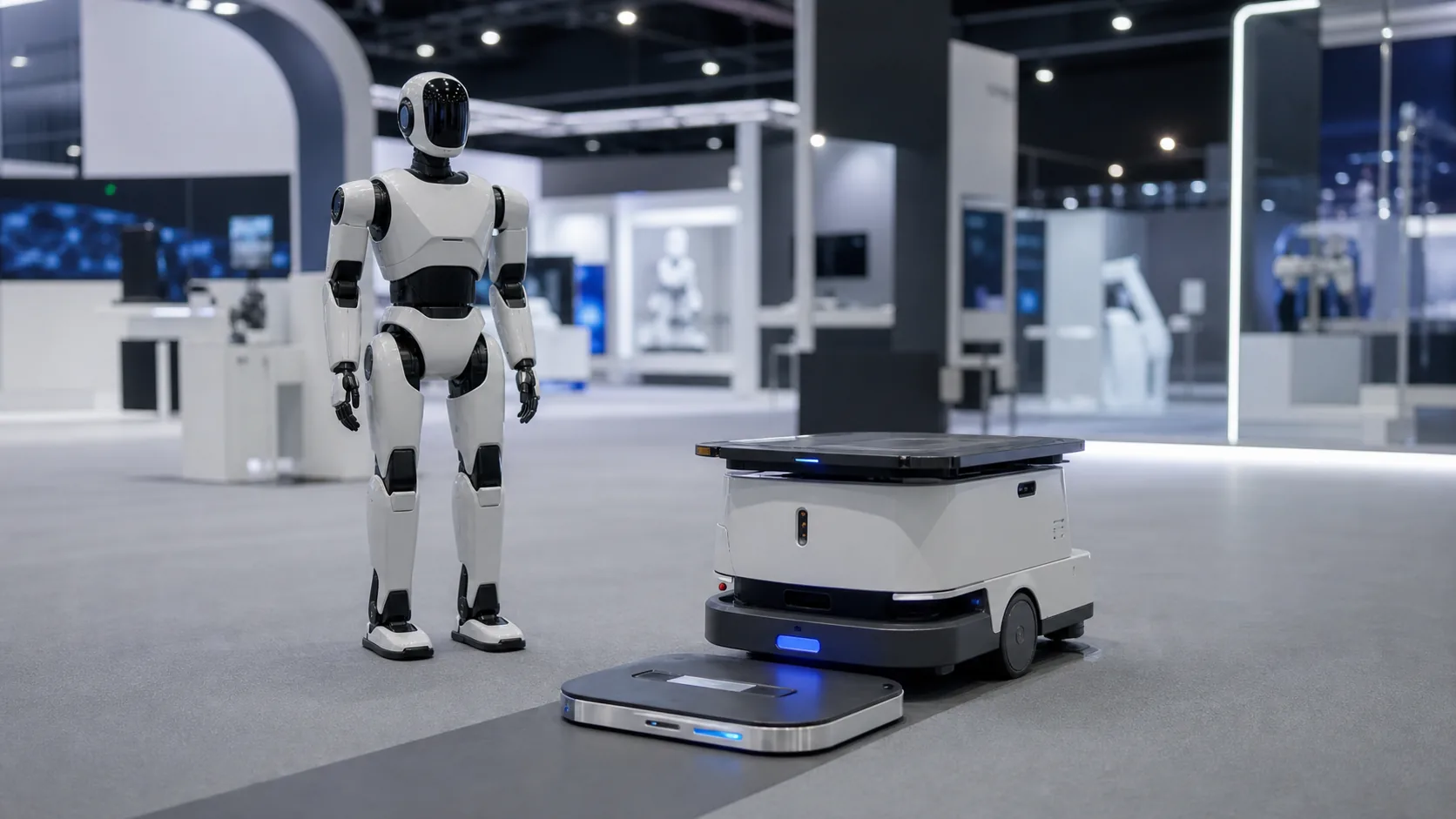
What charging trends emerged at WAIC 2026?
Joyson Electronics’ announcement dated 17 July 2026 included a bidirectional wireless power solution for robots alongside other embodied-AI components. This is a named manufacturer announcement, rather than a conference-wide finding or a specification for all robot chargers.
In the same announcement, Joyson reported a solid–liquid hybrid battery pack with energy density of 380 Wh/kg, wired and wireless charging support, and charging to 80% in about 30 minutes. These are manufacturer-reported figures. The announcement does not establish that the stated charging time applies to every wireless charging configuration, and the figures are not independently verified test results.
Automatic plug-in charging is a separate approach: a robot or docking mechanism mates a physical electrical connector. It can also support unattended charging, but should not be labeled wireless charging. Power rating, alignment, connector wear and safety controls need to be assessed for the actual design.
Why do embodied robots need autonomous charging?
Embodied robots are expected to move, perceive, handle objects, inspect equipment and interact with their surroundings in real-world environments. Because they are mobile and often work across long or repeated task cycles, dependence on manual charging interrupts the automation loop.
- Longer operating cycles: Robots working across multiple shifts need an automated way to recharge.
- Complex environments: Frequent manual cable connection reduces efficiency in factories, warehouses, parks and inspection sites.
- Larger fleets: Manual charging quickly becomes an operational bottleneck as deployments grow from one robot to many.
- Higher protection requirements: Dust, moisture, explosive atmospheres and outdoor conditions can make exposed connectors and manual plugging unsuitable.
Wireless charging versus automatic plug-in charging
Automatic plug-in charging still relies on physical contact and a mechanical system to align and insert the connector. It is a practical option for some high-power applications and fixed charging stations, but connector wear, positioning accuracy, maintenance and environmental cleanliness must be managed.
Wireless charging transfers energy without exposed plugs or repeated insertion cycles. For AGVs, AMRs, inspection robots, explosion-proof robots, waterproof robots, autonomous boats and selected embodied AI platforms, it can reduce connector wear, improve environmental protection and integrate naturally with automatic docking, fleet scheduling and battery management systems.
Where will robot wireless charging be adopted first?
Early adoption is most likely in applications with predictable routes, defined stopping points and a strong need for unattended operation. These include AGV and AMR logistics, substation inspection robots, outdoor autonomous inspection vehicles, explosion-proof inspection robots, greenhouse robots, autonomous cleaning boats and livestock farming robots.
These machines are expected to work reliably every day rather than appear only in demonstrations. The value of wireless charging is therefore not simply the absence of cables. It lies in reducing manual maintenance, limiting connector failures and keeping the overall robot system available for longer periods.
What does this mean for robot charging systems?
The direction indicated at WAIC 2026 is straightforward: the robotics industry is moving from machines that can move, perceive and perform tasks toward systems that can sustain those capabilities with less human intervention. Autonomous energy replenishment will become part of the infrastructure for embodied AI rather than an optional accessory.
Future wireless charging systems will be judged by higher power density, better tolerance for docking misalignment, stronger waterproof and dustproof construction, reliable communication and charging feedback, and closer integration with robot controllers, fleet management platforms and BMS interfaces.
Conclusion
Bidirectional wireless power, automatic plug-in charging and high-energy-density batteries all address the same practical challenge: robots need dependable autonomous energy replenishment before they can operate continuously in real industrial environments. Wireless charging will not replace every charging method, but it is well suited to high-frequency, unattended and high-protection robot applications where reliability matters most.