
Why Explosion-proof Rail Inspection Robots Use Wireless Charging
With the continuous improvement of industrial automation and intelligence levels, orbital inspection robots are increasingly widely used in fields such as electric power, chemical industry, mining, and rail transportation. Especially in hazardous environments such as flammable, explosive, humid, and high-voltage environments, the safety and reliability of inspection robots are particularly important.
Wireless charging technology, as a "non-contact, plug-free" energy supply method, is becoming a key configuration of explosion-proof track inspection robots. This article analyzes the value of wireless charging for explosion-proof rail inspection robots from application reasons, typical scenarios and technical advantages.
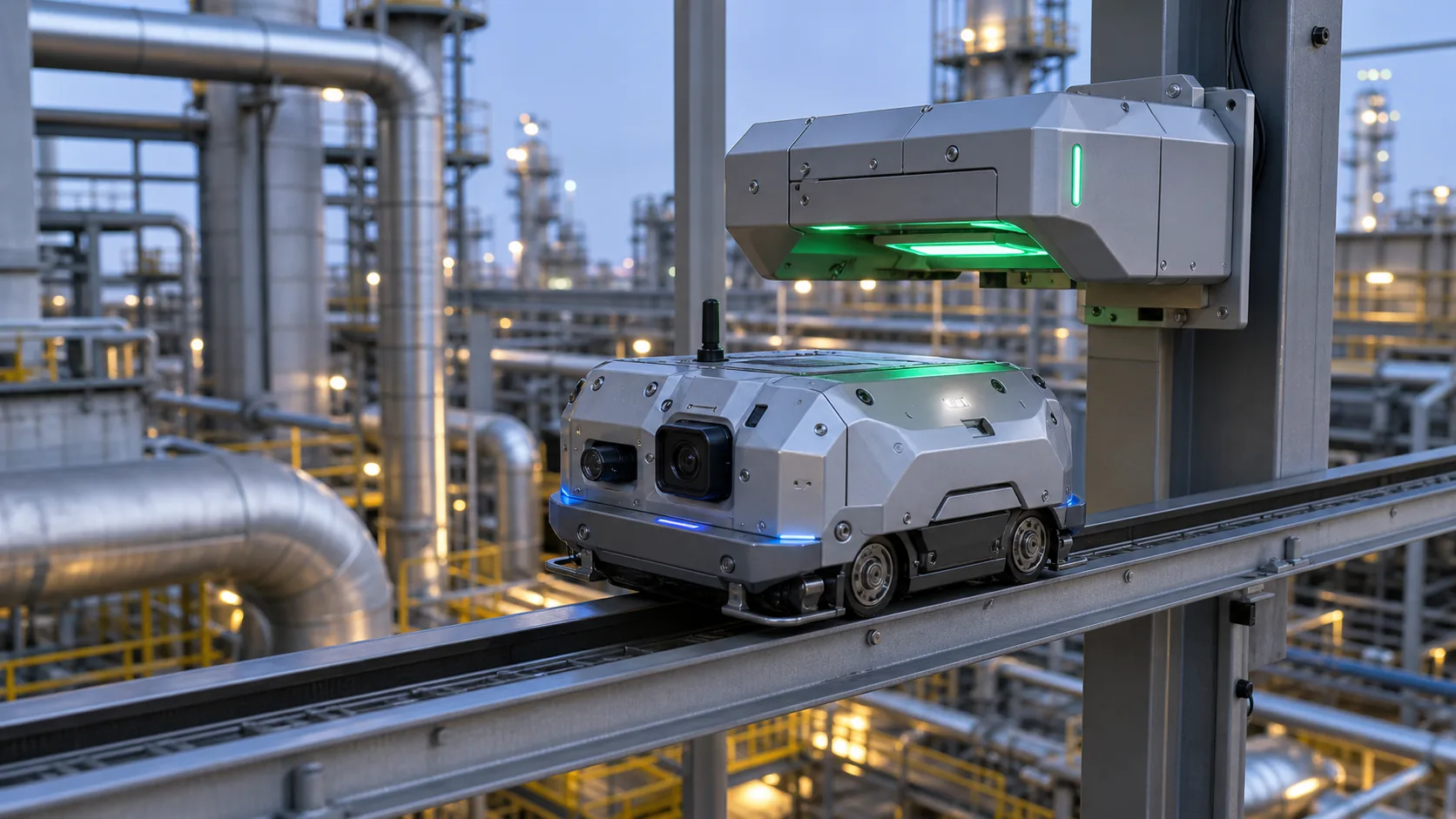
1. Why use wireless charging?
1. Safety hazards of contact charging
Traditional robots mostly use plug-in contact charging methods, but in explosion-proof or high-risk environments, this method has obvious flaws:
- Electric sparks are easily generated when plugging/unplugging, posing a risk of explosion;
- Humid environments can easily lead to contact corrosion or leakage;
- Metal contacts wear quickly and have a high rate of poor contact;
- There is strong electromagnetic interference around high-voltage equipment, which affects charging stability;
- Manual plugging/unplugging are required, reducing the degree of automation.
These problems make it difficult for contact charging to operate stably for a long time in explosion-proof scenarios.
2. Safety and automation advantages of wireless charging
Wireless charging technology realizes energy transmission through magnetic resonance coupling. There is no metal contact or sparks during the charging process, which can meet the safety requirements of explosion-proof scenarios.
Its core advantages include:
- Contactless charging: No need to plug or remove metal contacts, completely eliminating the risk of sparks;
- Highly automated: The robot can autonomously drive into the charging area to complete charging and achieve unattended operation;
- Strong environmental adaptability: Waterproof, dustproof, and anti-corrosion, meeting the requirements of complex environments such as moisture, dust, high temperature, and high pressure;
- low maintenance: No mechanical wear parts, reducing maintenance and replacement frequency;
- Flexible deployment: Can be hidden and installed on both sides of the track or tunnel wall, taking up little space.
Therefore, wireless charging is the best solution for explosion-proof track inspection robots to achieve safe, stable and continuous operation in hazardous environments.
2. Typical usage scenarios
1. Substations and high-voltage power facilities
In substations, track inspection robots need to frequently travel between high-voltage equipment. This area has strong electromagnetic interference, narrow space, and high risk of manual intervention.
Wireless charging allows the robot to automatically stop to recharge between inspections, avoiding the risk of cable damage or electric shock, and significantly improving the continuity and safety of inspections.
2. Subway and rail transit tunnels
Subways and traffic tunnels have high humidity, closed spaces, and limited manual access. Wireless charging allows inspection robots to automatically recharge at distributed charging points along the tunnel without manual intervention.
This design reduces the wiring difficulty and also improves the protection level and system reliability of the charging equipment.
3. Mine and chemical plant tracks
In mines or chemical industry sites, flammable gases or dust are often present in the air. The non-contact nature of wireless charging avoids sparks and arcs, fundamentally reducing the risk of explosions.
At the same time, the system can automatically recharge 24 hours a day, reducing manual maintenance, and is suitable for unattended continuous inspection tasks.
4. Factory production line and workshop track
Within the factory, orbital inspection robots are used for equipment status detection and safety inspections. Wireless charging allows the robot to automatically charge during production breaks, without the need for a dedicated charging area and without affecting the production line layout.
Its flexible deployment capabilities significantly reduce system integration costs and space constraints.
3. Technical advantages and implementation points of wireless charging
Technical advantages
- Explosion-proof safety: No metal exposure, no arc generation, meeting explosion-proof standards;
- High reliability: Not affected by dust, water vapor, oil pollution, etc., stable operation;
- High automation: The robot can position itself, charge automatically, and be unattended;
- save space: Wiring-free design, suitable for small environments;
- High efficiency operation: Support distributed fast charging mode to shorten downtime;
- low maintenance cost: Reduce plug wear and reduce the frequency of manual inspections.
Implementation points
- Efficient energy coupling: Optimize the coil structure of the transmitter and receiver to improve energy transmission efficiency;
- Intelligent positioning and alignment: Achieve precise docking through visual recognition or magnetic positioning system;
- Anti-electromagnetic interference design: Ensure stable charging in high-voltage or strong magnetic field environments;
- Explosion proof and protection level: Meets Ex explosion-proof standards and IP65 or above protection requirements;
- Charging scheduling system: The robot automatically determines the battery status and intelligently selects charging timing and routes.
4. Summary
The explosion-proof track inspection robot uses wireless charging, which is the best balance between safety, automation, environmental adaptability and operation and maintenance efficiency.
It effectively solves the many hidden dangers of traditional contact charging in flammable, explosive, high-humidity, high-dust and other environments, and achieves true "unattended continuous inspection."
In the future, as wireless charging power increases, efficiency is optimized, and costs are reduced, this technology will become a standard configuration in the field of track inspection robots, helping more industries realize intelligent, safe, and efficient inspection systems.