
Automatic Charging for Wheeled Humanoid Robots
Automatic charging for a wheeled humanoid robot involves much more than parking beside a charger. It is a complete process covering battery assessment, task scheduling, autonomous navigation, precision docking, charging authorization, safety monitoring and task resumption. A failure at any stage can prevent truly unattended operation.
A wheeled base provides stable movement and repeatable positioning, making it practical to use a fixed autonomous charging station. The robot can return according to battery status and its task schedule, recharge and then rejoin the work queue.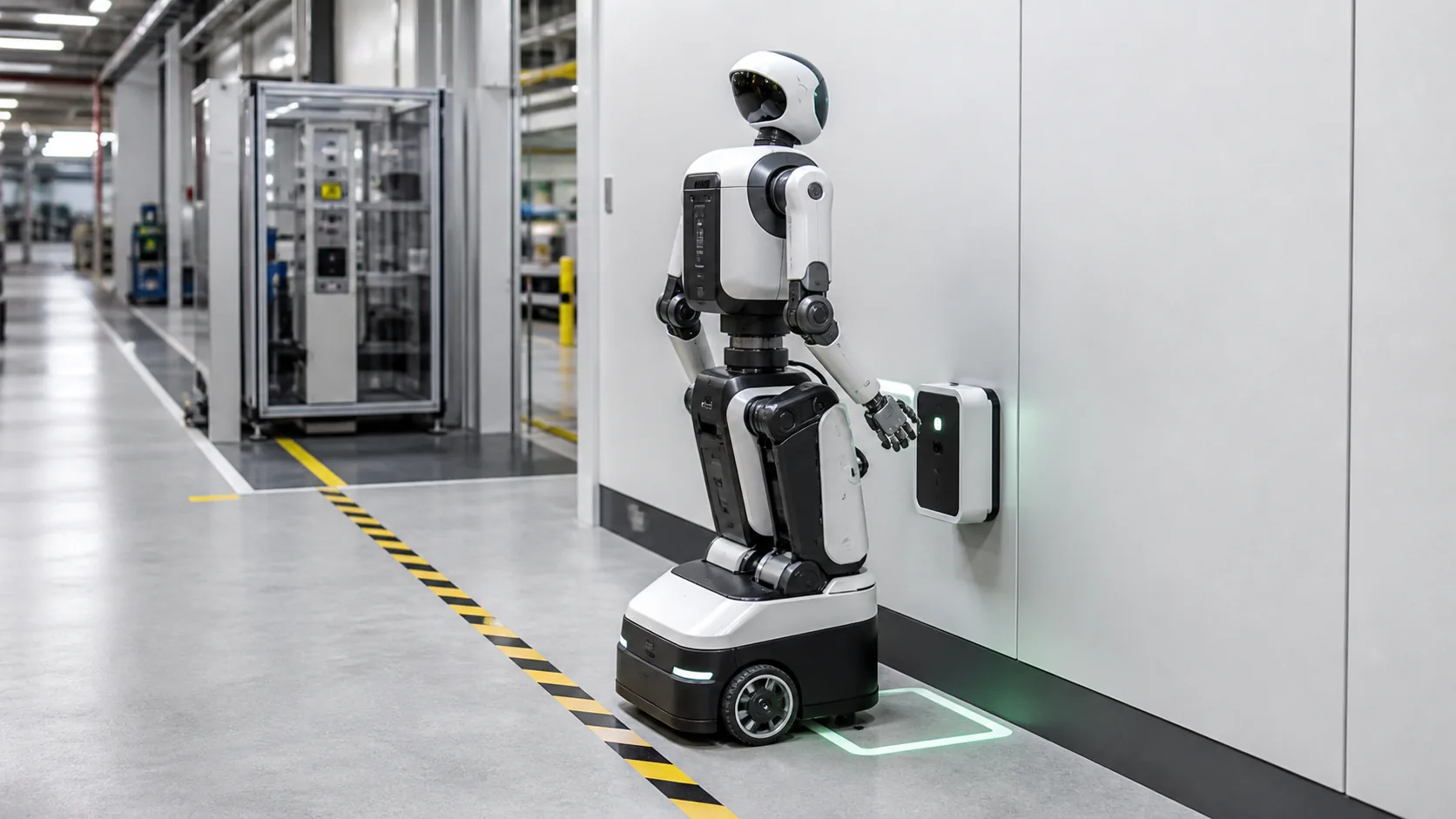
What are the main steps in automatic charging?
- Determine charging demand: The BMS reports state of charge, temperature and battery condition, while the controller decides when to return.
- Assign a charging point: Fleet management confirms availability and reserves a charger for the robot.
- Plan the return route: The robot navigates around obstacles and busy areas to reach the docking zone.
- Dock at low speed: Vision, lidar, floor markers or positioning references guide the robot into the permitted alignment range.
- Complete the handshake: The robot, BMS and charger confirm identity, connection status and permitted charging parameters.
- Monitor charging: Voltage, current, temperature, communications and robot position are checked continuously.
- Finish and resume work: At the target charge level, the system stops charging, releases the station and returns the robot to the task queue.
Which automatic charging method can be used?
Wheeled humanoid robots can use wireless charging, automatic plug-in charging or exposed contact charging. Wireless power avoids mechanical insertion and supports sealed construction and practical alignment tolerance. Automatic plugs can serve some fixed-interface or high-power applications. Contact systems are straightforward but require management of wear, contamination and docking accuracy.
Automatic charging describes the complete autonomous replenishment process, while wireless charging describes the method of transferring energy. The two work well together: the robot returns and docks autonomously, then charges through contactless power transfer.
How should the return-to-charge threshold be set?
A single fixed battery percentage is rarely enough. The controller should reserve the energy needed to reach the charger from the current location and consider remaining task duration, route distance, arm payload, charger queues and battery temperature. Urgent and routine tasks may also require different minimum energy policies.
In a multi-robot fleet, the management platform should prevent every robot from returning at the same time. Staggering charging according to task priority, remaining runtime and charger capacity reduces queues and improves fleet availability.
Required safety interlocks
- Position confirmation: Charging starts only when the robot is inside the permitted zone and fully stopped.
- BMS authorization: Battery voltage, temperature and condition must be within the allowed range.
- Fault shutdown: Overvoltage, overcurrent, overheating, foreign objects or communication loss must stop charging.
- Movement protection: Energy transfer stops before the robot moves away or leaves the alignment range.
- Fault reporting: Repeated docking or charging failures are reported to fleet management instead of creating an endless retry loop.
Conclusion
Automatic charging requires the robot navigation system, charging equipment, BMS and fleet management platform to work together. Closing the loop from return decisions and charger assignment through docking, safety authorization and task resumption is what turns a robot that can be charged into one that can replenish its own energy.