
Wireless Charging for Wheeled Humanoid Robots
Wheeled humanoid robots combine a mobile wheelbase with a humanoid upper body, robotic arms, vision and autonomous navigation. Compared with biped robots, a wheeled platform can provide efficient and stable movement on level floors, making it useful for factory operations, warehouse handling, commercial service, laboratory automation and site inspection.
The battery must power not only the drive system but also the arms, computing hardware, sensors and communications. Manual cable connection interrupts autonomous workflows. With wireless charging, the robot can dock at a compact charging point and replenish its battery through contactless power transfer.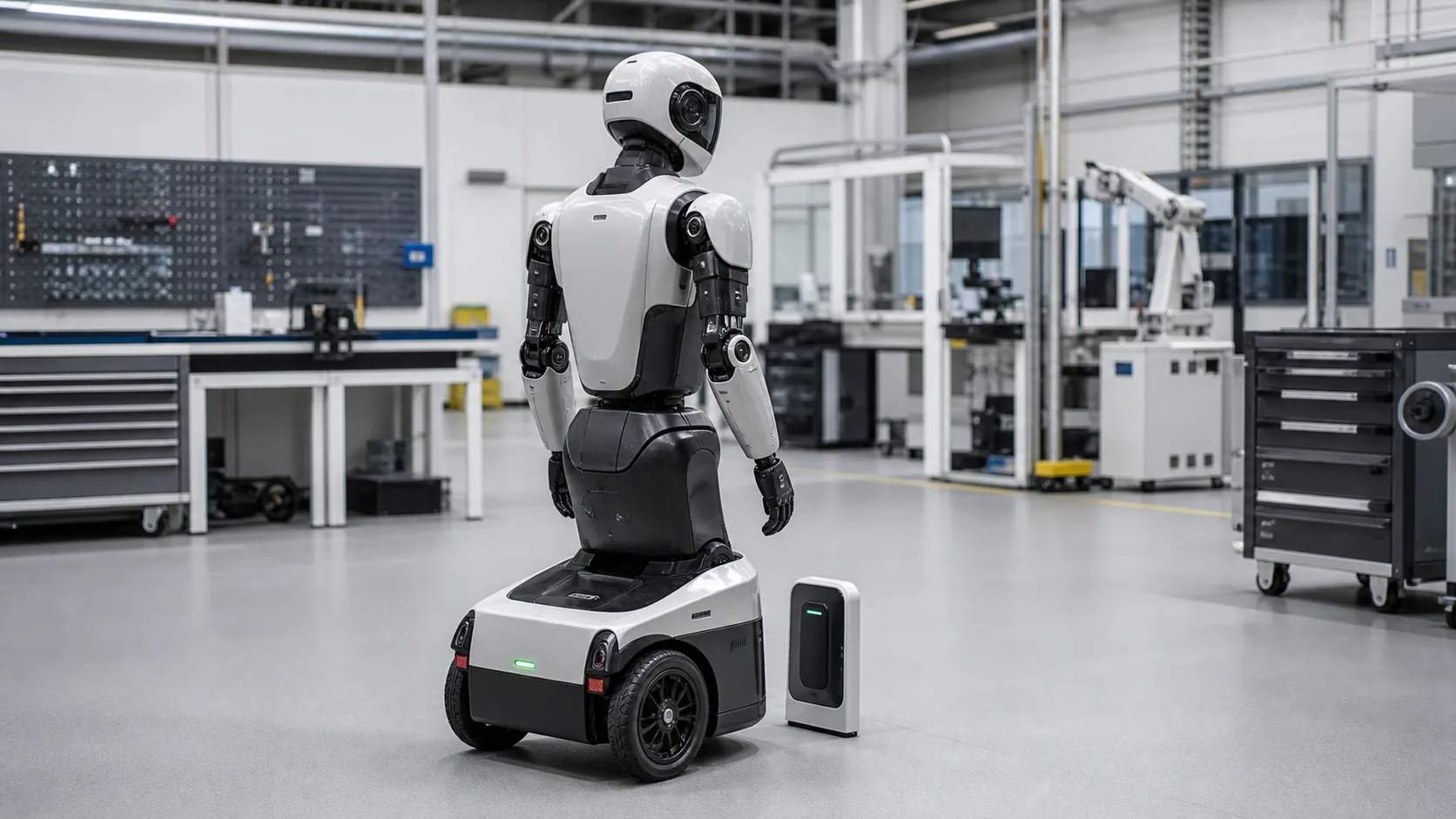
Why are wheeled humanoid robots suitable for wireless charging?
These robots already have autonomous navigation and repeatable docking capabilities, while the mobile base or rear enclosure can usually accommodate a receiver. This makes it practical to integrate charging into the robot controller without adding a mechanism to insert and remove a physical plug.
- Less manual intervention: The robot can return to the charger automatically when its battery is low.
- Lower connector wear: Eliminating repeated plug-in cycles reduces loose, oxidized and damaged contacts.
- Opportunity charging: Short idle periods can be used to recharge and increase operating availability.
- Better environmental protection: Contactless components are easier to seal against dust and moisture.
- Fleet compatibility: Multiple robots can share charging points under fleet management control.
Should the charging receiver be mounted underneath or on the side?
Underside mounting keeps the charging components hidden, but the design must account for ground clearance, debris and standing water. A side or rear receiver is easier to service and less affected by floor conditions, although it requires a defined docking orientation. The best arrangement depends on the robot structure, operating environment and parking direction.
The transmitter does not need to be a large platform. A compact low-profile or wall-mounted charging pad is generally easier to integrate into a docking area and less likely to interfere with people, cleaning equipment or other mobile robots.
Key system selection parameters
The charging system should be matched to battery chemistry, voltage, required power, allowable misalignment, transfer distance, parking time and installation space. Because the upper-body electronics and actuators may draw significant power, actual task and standby consumption should be considered alongside battery capacity.
The charging controller should exchange charging permission, voltage, current, temperature, fault and completion signals with the BMS and main robot controller. Protection should cover overvoltage, overcurrent, overheating, foreign objects, communication loss and movement away from the dock.
Typical applications
Wireless charging for wheeled humanoid robots is suitable for production-line operation, material delivery, laboratory automation, exhibition and commercial service, hospital logistics and industrial inspection. Its value is greatest when routes are predictable, docking points are defined and the robot must operate for long periods with limited supervision.
Conclusion
A wheeled humanoid robot needs an energy system that matches its autonomous movement and manipulation capabilities. A compact transmitter, onboard receiver and BMS interface allow wireless charging to reduce manual work and connector maintenance while supporting long-duration unattended operation.